Our Surprising God: A True Story

Our Surprising God: A True Story

Our Surprising God: The True Story of Isaac

by Elizabeth Turnage | Living Story Podcast

I have the great privilege of being on a team that leads a worship service once a month at the local jail. Last month, I decided you might enjoy hearing the message I delivered on the “true story” of God’s grace, so I turned it into a podcast. This month, I did the sequel, and have again posted it. I hope you enjoy listening to these true stories and that the Word seeps deep into your heart.

Note: I’m still a newbie to the podcasting work, so you can play it from this page, or scroll to the end of the page to download, or search for the Living Story podcast in iTunes.

This time, for you who prefer reading, I’ve included the transcript of the podcast :-)! Please let me know if you enjoy these. I love doing them and wouldn’t mind doing more :-)!

A true story about people who are tired of waiting on God’s surprising plan

Last month we considered the TRUE BIBLE story of two flawed women, one flawed man, and one amazingly gracious and faithful God. We remembered that God had a plan, a plan for a nation, a plan to redeem the world left broken by sinners. This plan would come about through one baby – the baby of Sarah and Abraham.

Abraham and Sarah have shown a lot of faith in leaving their homeland, Ur, and coming all this way[FIND OUT HOW FAR], and they’ve shown a lot of faith in trusting God to care for them and to fulfill his promise. But they’ve also stumbled a lot along the way.

In the true story we looked at last month, in Genesis 16, Sarah and Abraham decided to take things into their own hands and try to get this promised baby through Sarah’s maidservant Hagar. THAT was a disaster. THAT WAS CLEARLY NOT GOD’S PLAN!

Despite the fact that Abraham and Sarah keep making a mess of things, God continues to show them GRACE, FAITH, AND LOVE – the 3 words we talked about last month.

Do you like surprise stories?

Before we get into today’s story, I want to talk about SURPRISE for a moment.

Have you ever been really and truly surprised? Maybe either received a very surprising gift or given a very surprising gift? Or maybe had a surprise party?

I once heard of a woman who planned a great surprise party for her 12-year-old daughter. So she made a plan, and she invited everyone and told them all to keep it a secret. She got decorations and hid them at her neighbor’s house. She went to her neighbor’s house and made a cake. She worked for months planning the surprise. On the day of the party – which was NOT the girl’s birthday, her mom took her to the movies in the afternoon, and all of her friends and her neighbor got everything ready for the party. When the mom and the daughter walked into the house, everyone yelled SURPRISE!

But what happened next was NOT what the mom expected when she planned the party. HER DAUGHTER BURST INTO TEARS! Her mother was freaking out. She was afraid she did something wrong. But then her daughter started laughing and smiling and jumping up and down. She was SO HAPPY and GRATEFUL to her mom and her friends that she had started crying.

That is what SURPRISE can do to us. It can affect our emotions intensely.

God’s surprising plan is no secret…

Today we’re going to talk about how God is a SURPRISING GOD! God hasn’t kept his surprise a secret from Abraham and Sarah – from the beginning, he has told them he would bless them and give them a baby, that they would have as many descendants as the sand in the seashore.

What IS SURPRISING about God is how he keeps his promise even when they don’t keep theirs. What is surprising about God is how gracious and faithful and loving he is to people who aren’t always like loving and obedient to him. In fact, God is loving and gracious to them – and us – even when we don’t believe he will come through with his promise.

Abraham laughs at God’s surprising plan…

God keeps telling Abraham that he is going to give him a baby, and he keeps giving him signs of his love.

In Genesis 17:15, he repeated the promise, this time specifically saying it would be by Sarah,

“I will bless her and will surely give you a son by her. I will bless her so that she will be a mother of nations; kings of peoples will come from her.” Genesis 17:15

You know what Abraham did when he heard this?

“He fell facedown; he laughed and said to himself,

“Will a son be born to a man a hundred years old? Will Sarah bear a child at the age of ninety?” Genesis 17:18

And then Abraham asked God if maybe Ishmael could be the blessed son.

Rather than being “surprised” and delighted by God’s promise, Abraham doubts. He is not laughing because he’s happy. He’s laughing because he thinks it is impossible. And I think that sometimes I, sometimes we, are a LOT like Abraham.

This whole story we’re looking at today makes us ask,

“Are we laughing cynically – like, “THAT’S NEVER GOING TO HAPPEN!!!”

…or are we laughing nervously, even, “Hahahaha…that would be cool if it happened, but it’s probably not going to happen…”

…or are we laughing at the sheer hilarity, the stunning, shocking, SURPRISE that God has been that good to us and done something that impossible?

You know what God’s response was to Abraham laughing so hard he fell down?  You guessed it – SURPRISING. He simply says,

“Yes, but your wife Sarah will bear you a son, and you will call his name Isaac.”

It’s a joke. It’s not a joke because God is completely serious. But you have to know that the name Isaac in Hebrew means, Isaac means “He laughed.”

The God of surprising redemption…

You know what — God laughs at our cynical, doubting laughter, because he is the God of SURPRISING REDEMPTION.

In the true story we’re looking at today, God does something even more SURPRISING – he shows up in person.

READ GENESIS 18:1-15.

Let’s look at some of the surprises of this story:

  1. Surprise visitors. Abraham clearly isn’t expecting anyone, but it was not too (surprising) in that world for travelers to stop in and stay because there was no Quality Inn. At first, it doesn’t seem that Abraham recognizes that one of the 3 visitors is the Lord, even though we are told it is from the beginning. But even so, Abraham treats the visitors with great honor and hurries (it’s also surprising that this 99-year-old man is running around in the heat getting Sarah to cook bread and his servants to prepare a calf.) So, we could say he is happily surprised by his visitors.
  1. The surprise visitor is God. By verse 9, Abraham has to realize this is the Lord, because they ask, “Where is Sarah, your wife?” And since her name has just been changed from Sarai to Sarah BY THE LORD, that’s something only they would know. And in those days, God didn’t just go around visiting people, so it is a BIG SURPRISE that Abraham is visited by the Lord.
  1. Sarah’s surprise. Sarah is eavesdropping, hiding behind the tent, listening to the conversation. Imagine her surprise when she hears her name called! Imagine her surprise when she hears the promise, “I will return to you about this time next year, and your wife, Sarah, will have a son.”

The storyteller reminds us, in case we’ve forgotten:

“Abraham and Sarah were both very old by this time, and Sarah was long past the age of having children.” Genesis 18:9

Now, Sarah was surprised – but what kind of surprise is it? She laughs. TO HERSELF. Her response is similar to Abraham’s in Chapter 17 – “How could a worn-out woman like me enjoy such pleasure…!” She is afraid to imagine such a surprise. She doubts such a thing could be possible.

Have you ever felt like Sarah?!

If so, then you will love the next SURPRISE:

  1. The Lord talks to Sarah through Abraham, verse 13: “Then the Lord said to Abraham, ‘Why did Sarah laugh? Why did she say, ‘Can an old woman like me have a baby? IS ANYTHING TOO HARD FOR THE LORD?”

Remember – Sarah isn’t in plain view, and Sarah said this to herself. So God is surprising her by knowing what she’s thinking.

  1. The Lord talks to Sarah directly, and he is surprisingly gracious to her.

Because after God says this to Abraham, she gets afraid, and she lies – saying, “I didn’t laugh.”

“But the Lord said, ‘No, you did laugh.’” Genesis 18:15

Sarah LIED to God, but he forgave her, and he fulfilled his promise to her. THAT IS WHAT OUR SURPRISING GOD IS LIKE.

God pulls off his surprising plan…

And now we fast forward to ONE YEAR LATER. In the meantime, Abraham has AGAIN tried to pass his wife off as his sister, so as you can see, what happens next is another example of God’s surprising grace to people who have not done anything to earn it.

Read Genesis 21: 1-7

Let’s notice 3 things about this true story:

  1. How did it happen that Sarah and Abraham conceived a child?

v. 1: “The Lord KEPT HIS WORD and did for Sarah exactly what he had promised.”

  1. When did it happen?

At just the time God had said it would!!! Genesis 21:2

So, in a way, this is really NOT SURPRISING, because God has said all along that he would bring an heir through Sarah and Abraham.

  1. What was the effect, and who caused it?

LAUGHTER – and God brought it, verse 6.

Sarah’s response is similar to the overwhelmed response of the woman’s daughter. Except she doesn’t cry first.

Sarah is SURPRISED – not the cynical, doubting kind of surprise, but the nervous giggly kind of surprise …

The overwhelmed awe, that is amazing, wow, I can’t believe it’s really true kind of surprise that fills your heart and makes you want to laugh and cry and jump up and down and shout and tell the world, “I can’t believe this happened to ME!”

Abraham and Sarah name their baby laughter, because GOD HAD TOLD THEM TO.

Just think, whenever they call Isaac’s name, they will remember that they laughed at God’s promise, doubting, disbelieving, kind of wanting to believe, but not really sure. And he had the last laugh. Because he came through.

It is a SURPRISING GIFT. The gift of God’s grace, faithfulness, and love coming through to people who go in and out of believing his goodness.

God has an even more surprising gift in store…

But it isn’t the last surprising baby born in the Bible. Because this story points us forward to another, even more surprising true story of a baby born in even more impossible circumstances.

That baby is our Lord Jesus Christ, whom God promised would come to defeat all evil in Genesis 3:15.

That baby is a fully human, fully divine baby, come to earth to call sinners to repentance. That baby grew in wisdom and stature and in favor with God and man to live a perfect life and die a sacrificial death.

That baby was the MOST SURPRISING BABY – THE MOST SURPRISING GIFT…

Of a faithful God to people who aren’t always so faithful.

So as we wrap up this story, let’s just notice a few things about our surprisingly gracious God, our perfectly holy God, the great planner of the best surprises.

  1. We shouldn’t be so surprised when God does impossible things.

God asks a question we should all ask ourselves,

“Is anything too hard for the Lord?”

When we are in tough circumstances, we need to remember this question.

  • Then we need to remember all of the ways God has been faithful in the past.
  • We need to remember the surprising “laughter” of redemption – in the Bible, and in our own lives.
  • We need to remember that Jesus has not only saved us from our sins, but he is changing our hearts.
  • We need to remember that nothing can separate us from the love of THE SURPRISING GOD who is working all things for his glory and our good.

SO WE SHOULDN’T BE SO SURPRISED at what the Lord can do.

  1. It IS the best surprise EVER that God is such a friend to sinners.

He comes to visit Abraham as a FRIEND.

He is being a good friend to Sarah in also ‘visiting’ her but doing it in a way she can handle. He is gentle with her in correcting her lie, and gracious to fulfill his promise. That is what it means to be a FRIEND to SINNERS.

But even more surprisingly, JESUS WAS A FRIEND TO SINNERS. If you ever doubt that Jesus wants to be a friend to a person like you, to a person who has messed up her life pretty bad, I dare you to read the Bible. I dare you to ask around. Because Jesus came to be a friend to sinners, and to give us a way back to being friends with God.

In Romans 5:10, it says,

“For since our friendship with God was restored by the death of his Son while we were still his enemies, we will certainly be saved through the life of his Son.”

SO YES, GOD IS FULL OF SURPRISES, AND EVERY SINGLE ONE OF US SHOULD WALK AROUND ALL THE TIME LAUGHING HILARIOUSLY, NAMING OUR KIDS AND OUR DOGS AND OUR FRIENDS ISAAC, BECAUSE GOD HAS PUT SO MUCH SURPRISING GOODNESS IN OUR LIVES BY HIS GRACE, FAITHFULNESS, AND LOVE!
Photo credit: Copyright: sutichak / 123RF Stock Photo
Did you enjoy this TRUE STORY?! Share it with someone you know who needs encouragement!

Get free printable prayer worksheet and cards

5 [Un]Surprising Things about Correctional Ministries

5 [Un]Surprising Things about Correctional Ministries

Correctional Ministries Summit

“I was beaten with a braided extension cord by my mother, who ran a bootleg house.” Pastor Tony Lowden, Executive Director of Stone Academy, shared those words as he raised this puzzling question:

WHY did I escape the imprisonment every other male member of my family has experienced?

His answer (ET translation of a very profound “plenary”):  “I got hung up on a nail.”
The nail of God’s love which held Jesus to the Cross, the only sure anchor in this life, saved him from his seemingly certain incarcerated future.

My story with Correctional Ministries

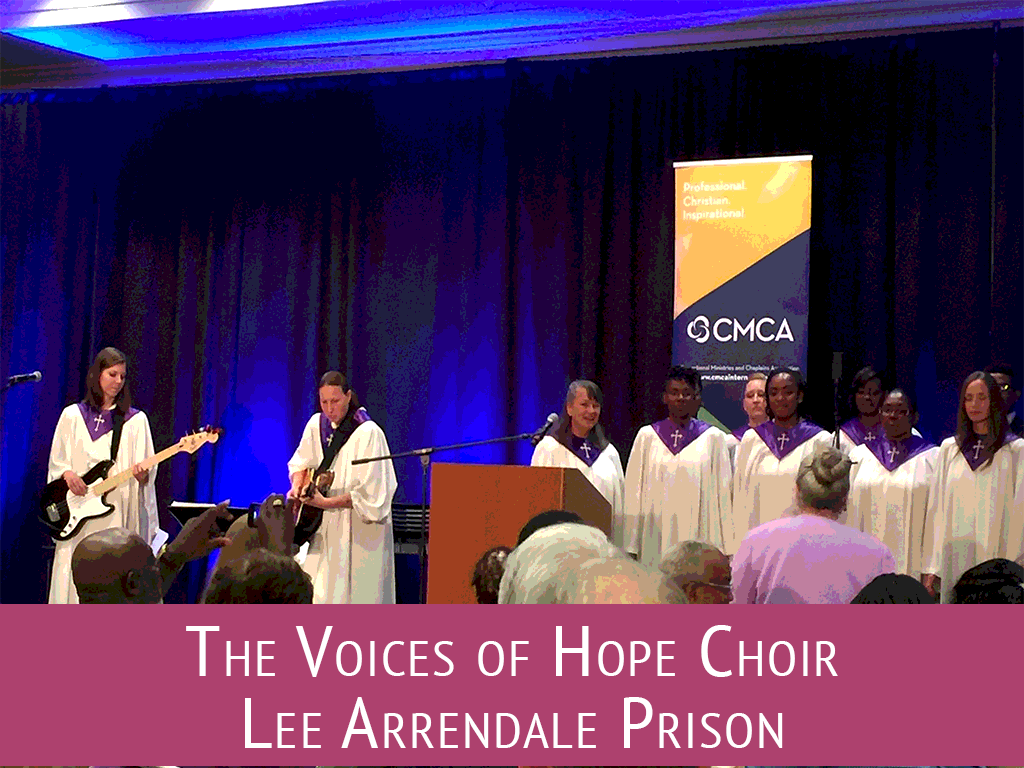
Lowden’s was among the many strong and compassionate voices speaking this past weekend at the Correctional Ministries and Chaplain’s Association Summit in Atlanta, Georgia. I spent 48 hours as a newbie to correctional ministry soaking up astounding statistics and stories about the impact these ministries are having on real people. I wept with others over songs shared by the Lee Arrendale Women’s Prison Choir. I sat under men and women solidly secure in their belief that the gospel is the only story that offers true hope to the dark reality of incarcerated men and women in America.

How did I come to be in this place? The whole story would require an additional blog. For now, let’s just say that a gentle, quiet question started forming in me about 2 years ago, “Should I become involved in prison ministry in some way, shape, or form?” I know I have teaching gifts, which I’ve used for over 25 years in white middle class churches and beyond. Should I try to use them in a different culture?

I did what I encourage my coaching clients to do – prayed, listened (to God and others), sought, waited. Last fall, an opportunity came to join a team of 4 delightful women, who, like me, don’t know much about correctional ministry (that’s the phrase that includes prison/jail/re-entry ministry) except that we have some gifts and want to help.

5 [UN]surprising things correctional ministries taught me

I AM LEARNING SO MUCH!!! And I’m so eager to share with you. So, here are 5 (out of about 50) at first surprising but really unsurprising things about correctional ministry.

  1. Are prisoners people too? Genesis 1:26-28.

    Too often, we see mug shots or read stories of a crime in the paper, and we jump to a conclusion — thug, druggie, evil. Our labels may be partially accurate, but they don’t tell the whole story.

One morning at the jail, after the worship service, we rode the elevator down with the inmates. The tall freckle-faced young woman in the orange jumpsuit had her pretty red hair pulled back in a high ponytail. She eagerly told us about all the books she had been reading while recovering from an injury in the infirmary. I could not shake the thought – I could as easily be in my living room listening to one of the girls on my daughter’s volleyball team.

Every incarcerated person is created in the image of God and bears his glory, no matter how well disguised it is by evil. Share on XI need to recall: Every incarcerated person is created in the image of God and bears his glory, no matter how well disguised it is by evil.

  1. What do the incarcerated need most?

    Mark Casson, executive director of Metanoia Ministries, a highly effective mentoring and re-entry program, graciously gave me an hour of his time. He posed this question of me.

As I searched my mind for the answer — “Car? Job? House,” he interjected.

“THE CHURCH!” He quoted Matthew 6:33: “But seek first the kingdom of God and his righteousness, and all these things will be added to you.” At first, I wondered – “Is he being practical?” But he explained that in churches, many “returning citizens” will not only be encouraged by the gospel, but will also be connected to resources for practical needs.What the incarcerated need most -- THE #CHURCH! Matt. 6:33 #prisonministry Share on X

  1. Which “culture” is more spiritual? Prison or America?

    Prison! In a spot-on workshop on re-entry, Mark explained that prison often affords many hours for Bible reading and praying. At the same time, it protects the prisoner from some of the temptations presented in American culture. He added that many incarcerated people may often experience rapid spiritual growth because of the time they spend in God’s Word.

  1. “Who’s the guy”?

    Dr. Harold Trulear, of Healing Communities, pointed out that 9 times out of 10 — yes, he said 9 times out of 10, when women are incarcerated, there is a guy involved. Not only are women prostituted by men, they also run drugs or buy guns for men. He added that where a man was not directly involved, emotional, physical, and spiritual abuse often influences women’s crimes.

  1. How can we help?

    You may not have a calling to correctional ministry, but all Christians are called to play a vital role. Here are some things you can do:

  • PRAY: Pray against the enemy and evil. Pray for…
    • the incarcerated and victims of crime
    • families and children of incarcerated and victims
    • correctional officers
  • HELP BY NOT HELPING: Rob Kendall, director of Against the Grain (http://www.atghope.org), exhorted us, “Don’t do things for people they can do for themselves.”
  • LEARN MORE: Prison Fellowship has one of the largest correctional ministry outreaches in the country. On their website, you can learn about prison reform, restorative justice, and more.

We all need correctional ministry.

I was talking to a wizened African-American woman, a coordinator of programs at a prison in Michigan. I explained that I was new to the conference and correctional ministry, but that I had been teaching Bible study in church for many years. She leaned over and took my arm and said, “You know, honey, you’ve been teaching prisoners, too. We’re all prisoners of sin.” What a wonderful encouragement to us all to continue to bring the hope of the gospel wherever we go.


Is God Your Mother?

Is God Your Mother?

Is God your mother?

I’ve always loved that beginner book by P.D. Eastman where the hatchling bird goes around and asks elephants and boats and steam shovels, “Are you my mother?”  As I revisit the Creation chapter of Learning God’s Story of Grace, I am thinking about Genesis 1:26-28:

So God created human beings in his own image.
    In the image of God he created them;
    male and female he created them.

I remember when a teacher first enlightened me — this verse suggests that both male and female reflect God’s nature. It was the beginning of the end of my picturing God as a cross between Great Grandpa in the Sky and Santa Claus.

The problem of God as mother

This much is true — it is far too easy to lose the femininity of God in the abundance of masculine language in Scripture. That being said, this is where the conversation can get a little crazy. Today, I want to focus particularly on the discussion of God as mother.

Some feminist theologians, concerned that women are marginalized by so much male language for and about God, suggest that we may call God Mother as well as Father.

Many conservative theologians strongly disagree, stating that biblical language guides us, and it names God as Father.

How do we approach this theological difference (and others, for that matter)? I’ll offer 3 suggestions, share some quotes from both sides, then reveal my conclusion on the matter.

Caution in the conversation about God as mother

  1. Whichever side you’re on – be humble and kind. Writers and speakers on both sides can be caustic and/or flippant. Always, always, in theological conversation, we need to be “kind to one another.”
  1. Study the Bible and ask the Holy Spirit to reveal the truth. Don’t merely read what someone you agree with says. Read what the Scriptures say, in the context of all of Scripture and the particular verse and story.
  1. Remember that God is the Creator and Redeemer, and we, including our minds, are fallen. In any theological exploration, we may discover something we don’t like or don’t want to be true. At this point, it’s crucial to recall that “now we see in a glass darkly, but then we shall see face to face.” We will be called to greater faith – to trust that God’s good and glory is involved.

3 thoughts on God as mother

Check out these 3 resources that suggest God may be called “Mother,” or addressed with feminine language.

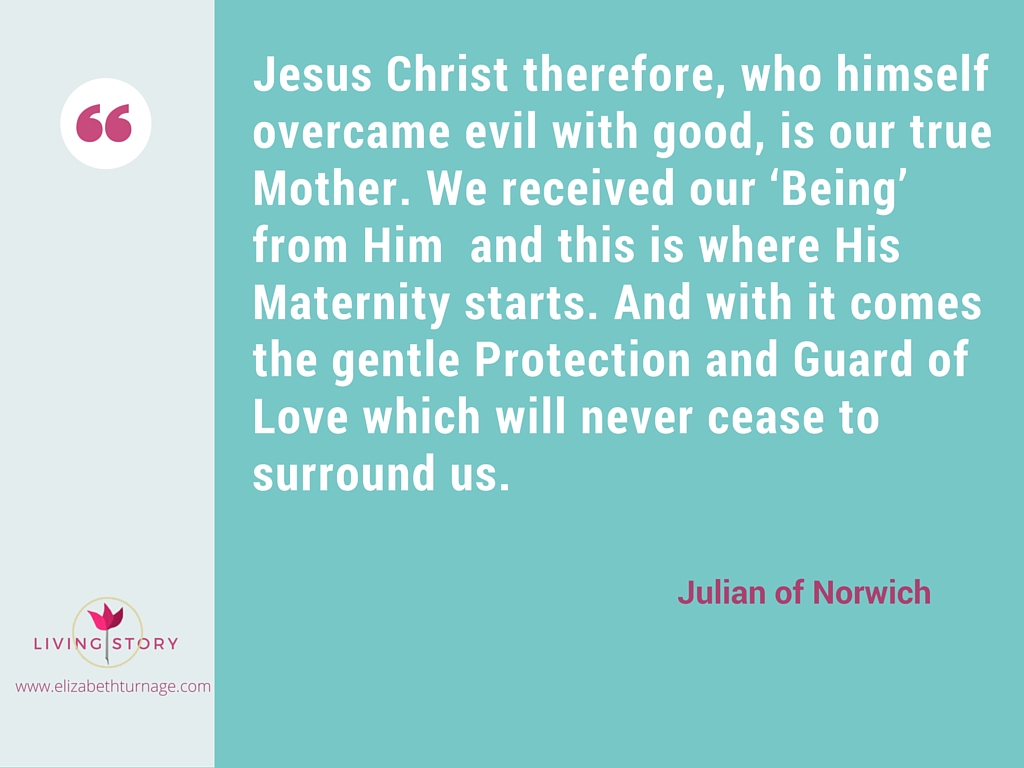
  • Julian of Norwich, 1342-1416, wrote that Jesus is our metaphorical Mother.
  • Elizabeth Johnson, feminist theologian, points out that no language can comprehensively communicate the nature of God.
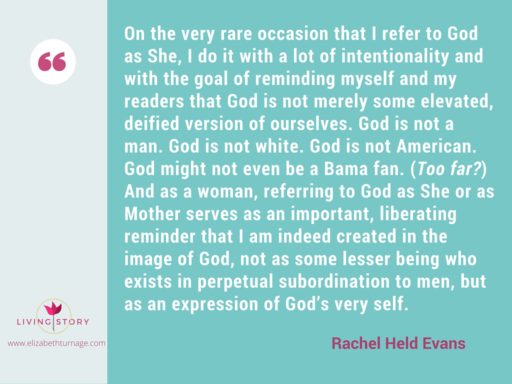
  • Rachel Held Evans, author of A Year of Biblical Womanhood, uses the feminine pronoun to remind us that God is not a mere man.

3 thoughts on God as Father

Check out these 3 resources that explain why God should be called Father.

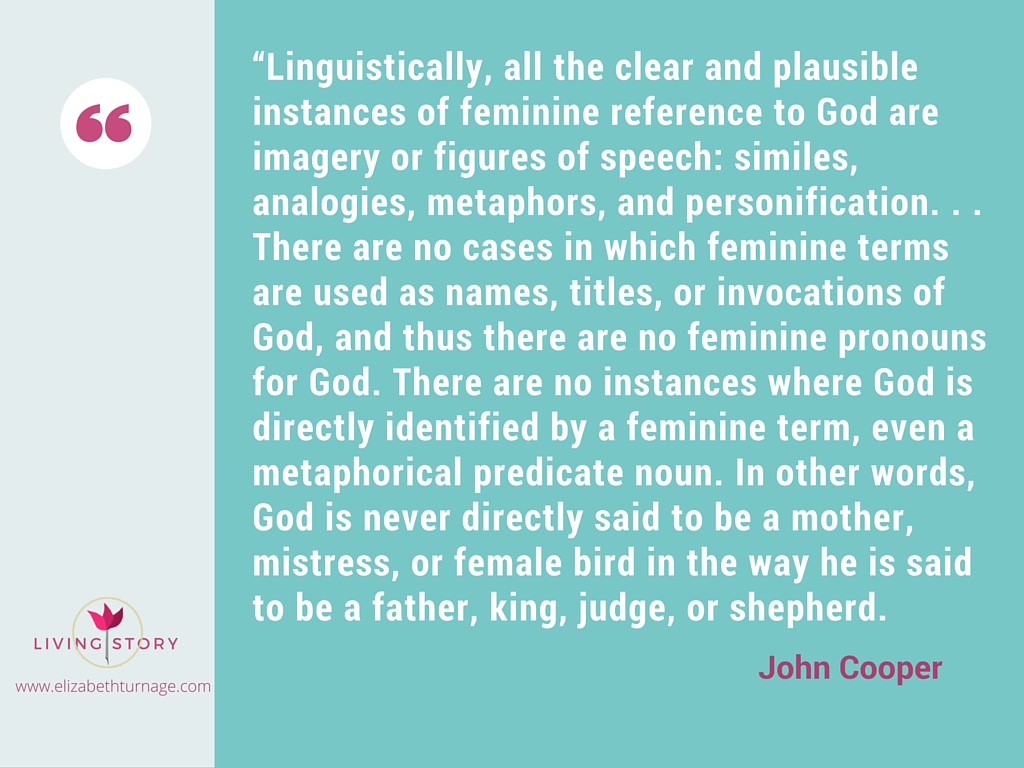
  • John Cooper, author of Our Father in Heaven: Christian Faith and Inclusive Language for God, emphasizes the difference between calling God Father or Mother – the Bible names God as Father; it never assigns the title Mother to God.
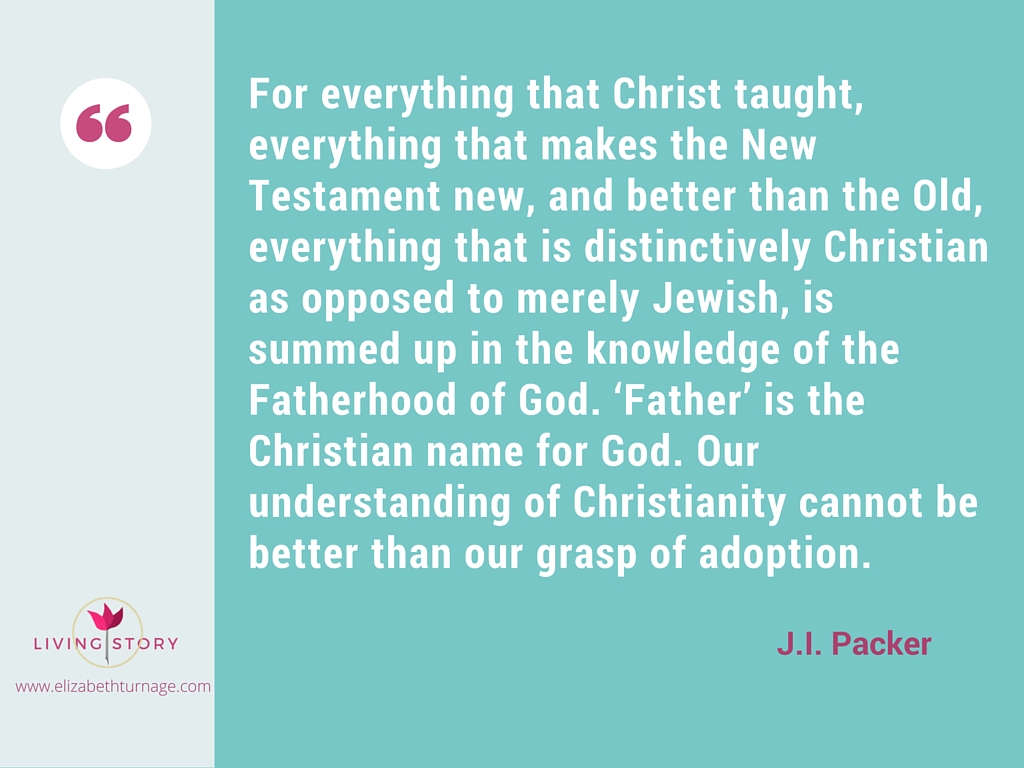
  • J.I. Packer, theologian, author of Knowing God, stresses that the concept of Fatherhood is woven into the fabric of adoption theology. For more on the first two authors’ thought, see Our Mother, Who Art in Heaven.
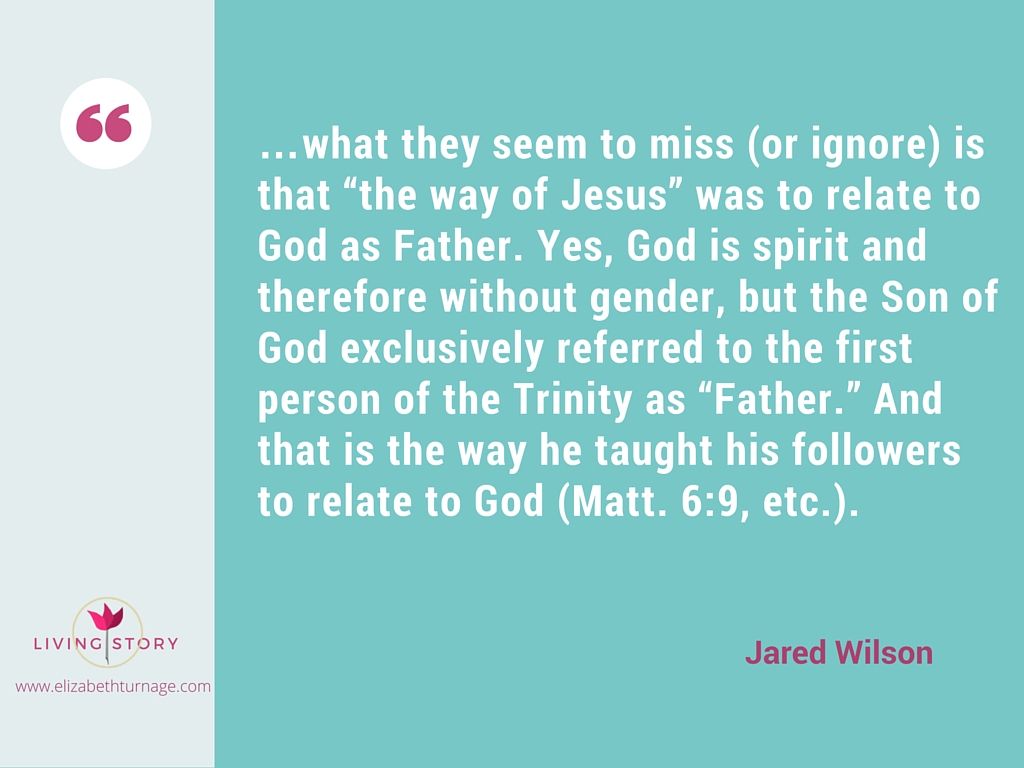
  • Jared Wilson, pastor and author, notes that Jesus called God Father and never Mother.

My Conclusions: Is God My Mother?

  1. God is Spirit (Genesis 1:2; John 4:24).
  2. There is something about both male and female that reveals God’s nature (Genesis 1:26-28).
  3. Jesus called God, “Father,” and taught us to pray to God as Father (Mark 14:36; Matthew 6:9).
  4. There are numerous comparisons to God as a mother (Numbers 11:12; Job 38:28-29. See this article for a comprehensive list).
  5. God the Father adopted all believers as his “sons” (Galatians 4:4-5). In Christ, there is neither male nor female, so I too as a woman am a “son of God” (Galatians 3:28). (Yes, this is confusing ;-)!! The point is – our gender language fails to fully communicate the wonder of who God is and what God has done in Christ to save people who have presumed that we know better than God.

So, yes, I will pray to God our Father. I will not pray, “God, our Mother.” I will remind myself and others often that God is not a man, that he is definitely not a Bama fan, and that he is often compared to a mother in her capacity to conceive, nurture, grow, and show mercy and compassion.

And…I will need to be frequently humbled and forgiven for holding this position too tightly :-)!

How to Meditate for Ordinary Christians

How to Meditate for Ordinary Christians

Love & Meditation

It’s the LAST week of February. I don’t know about y’all, but this one’s flown for me. What that means is it’s time to wind down our “love” focus (who am I kidding — y’all know this whole blog is about Living the Story of God’s Love for Us;-)!

So what, you might ask, does Christian meditation have to do with love? Well, think about it this way — when you love someone, do you meditate on them? Do you think about them frequently, if not, in the case of early love and crush love — constantly? I think meditation is one of the ways we not only express our love for God but also grow our love for God.

Now here’s the problem — for me. Maybe for you? Somewhere along the way, Christian meditation became intimidating to me, something seemingly so high-minded only a monk with super-spiritual credentials could do. Somewhere along the way, Christian meditation became intimidating to me, something seemingly so high-minded only a monk with super-spiritual credentials could do. Share on X

As a young Christian, I learned verses like…

Ps. 1:2: “But his delight is in the law of the LORD, And in His law he meditates day and night…”

and

Ps. 104:34: “Let my meditation be pleasing to Him; As for me, I shall be glad in the LORD.”

I was taught that meditation was simply slowing down and thinking about God, particularly by dwelling on Scripture.

When I read Eugene Peterson’s Eat This Book, I loved his analogy of meditation as like a dog with a bone:

“He gnawed the bone, turned it over and around, licked it, worried it. Sometimes we could hear a low rumble or growl, what in a cat would be a purr. He was obviously enjoying himself and in no hurry. After a leisurely couple of hours he would bury it and return the next day to take it up again. An average bone lasted about a week.”

Learning to Love Meditation

The key to rediscovering and reclaiming meditation as a spiritual practice is to bring it back down to earth. Share on X It will also require that we do the seemingly impossible in our time — slow down and chew on a portion of Scripture.


“The key to rediscovering and reclaiming meditation as a spiritual practice is to bring it back down to earth.”

Here are 4 methods that have helped me learn to love meditation:

  1. Read a portion of Scripture aloud several times.
  2. Write the Scripture down in a prayer journal. (Or on prayer cards).
  3. Play with the verses in a way that forces me to slow down and think about them. I am a kinesthetic learner in part, so using my hands to interact with the Word helps me to do this (Drawing, cutting and pasting, lettering, etc.)
  4. Don’t overcomplicate it. The hardest part about meditation is the time and concentration it requires – much more than skimming a Facebook or Twitter feed but way less than watching a 30-minute sitcom on TV.

I AM NOT AN ARTIST:-)!
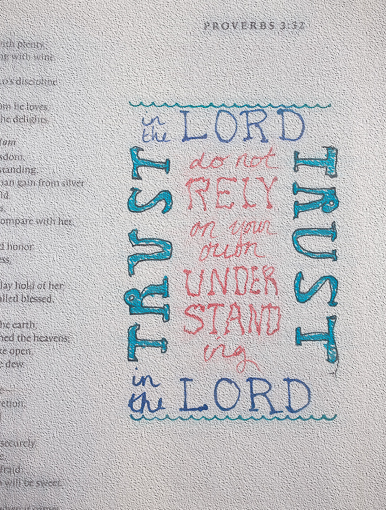
But that doesn’t mean I can’t “do art” and share it. In the same way, I am not a super-spiritual person, but that doesn’t mean I can’t do meditation. Below are 2 meditations I did with Bible journaling, my camera, and some digital software. The whole time I “played” with these, I thought about who God is and how much I love him.

Do you have some helpful methods that help you meditate on Scripture? I’d love to hear them.

Forgiveness: What You Have to Know to Do It

Forgiveness: What You Have to Know to Do It

February isn’t just for Valentine’s….it’s for forgiveness…

In January, the blog focus was on using story to make goals and plans (stay tuned for the exciting new online story planning course if you want to do more with your plans!!).

It’s February, and we know what that means — L – O – V – E! But if you are an anti-Valentine’s Day party-goer-or-thrower, HOLD ON!!!

Because this month we’re going to immerse ourselves in THE source and essence of LOVE — GOD!

Forgiveness is critical to love…

Who is a God like you, who pardons sin and forgives the transgression of the remnant of his inheritance? You do not stay angry forever, but delight to show us mercy. You will again have compassion on us; you will trod our sins underfoot and hurl all our iniquities into the depths of the sea. Micah 7:18-19

Really, who? Are we amazed by God’s forgiveness? Do we live in awe that…

  • he does not stay angry forever?
  • he delights to show mercy?
  • he keeps having compassion on us and hurls our iniquities into the sea?

If you have ever dared to love, you have needed forgiveness. Share on XIf you have ever dared to love, you have needed forgiveness. We all fail to love sacrificially and steadfastly, every day. And others fail us. We need forgiveness, and we need to forgive.


How do we learn the language of love — forgiveness?

John says that God’s love compels our love. So we must ask, HOW? 

I’m not going to pretend that one short blog post is going to solve your struggle with forgiveness. That happens as the gospel is massaged in to our hearts over time.

But I do have 3 specific suggestions for getting started.

  1. Take an Alaskan-view-look at God’s forgiving love. You know Alaskan-view-look? The kind of hole-mouthed, chin-raised, fixated-stare you proffer to massive mountains sliced by icy glaciers? We need to do this with God’s forgiveness.
  • Scroll up and read Micah 7:18-19 aloud at least twice. Ask that question of God — “Who are YOU?” and spend some time marveling at this God. It’s truly a puzzling story.
  1. List at least 20 sins God has forgiven you*. (You’ll probably want to do this in a private place, right? Because I know there are things on my list that will always stay between God and me. The atrocities that make me look back and say, “I can’t believe I did that.” (Note the lack of humility in that statement:-). But I don’t need to tell you all of them — just God.) Now, go back to Micah 7:18-19 and repeat again, “Who are YOU, GOD?”
  1. Love your enemies and bless those who persecute you. Ouch. That’s impossible. Yes, and Jesus tells us to do it in Matthew 5:44. Paul offers entire paragraphs explaining love that include this admonition.

How do we forgive our enemies?

Forgiving your enemies is hard, and it’s a process, sometimes a very long one.  Where there has been deep betrayal and/or abuse, it may be best to work through some of these with a trusted friend, pastor, or counselor.

That being said, we know that the gospel works in us to help us love our enemies and bless those who persecute us. Here are some actions you can take to “work out your faith with fear and trembling.”

  • Write their names and the wrongs they have done to you. (In that private place). (Forgiveness is neither denial nor excusing sin).(You can tear it up or delete it after you’ve written it.)
  • Write any ways you have repaid that person evil for evil or ways you’ve wanted to take revenge.
  • Ask God to take your anger or resentment and transform it into longings for healing for that person, and if possible, your relationship. (Forgiveness does not require reconciliation with an unrepentant sinner who is continuing to harm).
  • Pray for them. (Jesus said so). Write their names here, and ask God to renovate their hearts, to give them a gift, to show them a kindness. Beware: you might be part of God’s answer to that prayer:-)!!
  • Be patient in hope.
  • Start all over again and do it at least 490 times*, or until forgiveness sets in, whichever comes first:-). (Jesus told Peter to forgive 70 times 7 times. Most scholars believe he meant infinitely, but Margaret Feinberg playfully suggests that 490 times might be enough to change our hearts:-).
  • Write down any changes in heart you see along the way. 

Will you be finished forgiving that person when you’ve done all these things? Maybe. Maybe not. We cannot control how long forgiveness takes. We do know (at least) one thing. In Christ, God forgave us our debts; in Christ, we forgive our debtors. Our heart-renovation has begun; ministers of reconciliation we have become. Share on XOur heart-renovation has begun; ministers of reconciliation we have become.

Join me this month as we celebrate TRUE LOVE — God’s love. Subscribe to the blog so you won’t miss a single post — I promise not to stuff your inbox, and you will be the first to receive Living Story free resources!

*I owe this wonderfully challenging exercise as well as the idea of forgiving 490 times to Margaret Feinberg’s excellent chapter on Forgiveness in her workbook, Wonderstruck.


5 Ways to Have a Happy Thanksgiving

5 Ways to Have a Happy Thanksgiving

Is there really such a thing as a Happy Thanksgiving?

If you’ve been reading this blog for a while, you probably know that title’s a bit tongue-in-cheek. I tend to be a bit of a holiday cynic who recognizes that these “happy” occasions aren’t necessarily happy for all people. I don’t believe in “just put on a happy face” and the “sun’ll come out tomorrow.”

AND YET. I do believe that the gospel does lead us to a place of “happy,” “Thanks” and “giving.”

Here are 5 things the gospel tells me about “Happy Thanksgiving.”

  1. “Happy” means to a Christian far more that we are blessed, and it only takes a cursory glance at Luke 6:20-26 or Matthew 5:3-12 to see that blessing in the Christian story comes often from circumstances considered “unhappy” in the American story.
  2. “Thanks” often translates the Greek word “charis” in the Bible, the same word that means “grace.”
    What grace has operated in your life to bring you to today? Where have you known God’s favor? These are places to start with “thanks,” and they usually lead to many more.
  3. “Giving,” another core concept of the Christian narrative. In our story, it is impossible to receive grace without responding. Yes, we are called to “give thanks” to God for his mighty favor in our lives, but we are also called to give “thanks” to others by…
  4. “living” faith, hope, and love into others’ lives — “because he first loved us.” Whom will you love today, this week? How?
    When we love others, especially those who are different from us, we are living Thanksgiving in a way that will bring “happiness,” not just blessing but a true sense of joy, delight, rest, and contentment — shalom!
  5. Turkey. Despite the fact that I have a heart to live a happy thanksgiving in my life, I’ll probably end up being a turkey at some point in the next week. That is, I may throw  a very unhappy pity party for myself somewhere along the way. May I never forget, when I do turn inward in sin, that the good news, the happy news, for which I am thankful every day is that I am a sinner saved by grace!

So there you go. Happy Thanksgiving. Now it’s your turn. Share YOUR ideas on having a “Happy Thanksgiving.” Don’t forget to include practical things like “don’t forget to thaw out the turkey!” :-)! Also, make sure to sign up for the free Thanksgiving story topics if you want more inspiration!

Get Advent Devotional: Finding Rest in Christmas Now!