Eugene Peterson Tells the Story
Eugene Peterson, biblical languages scholar, people’s pastor, Scripture storyteller, has done it again. Over 20 years ago, Peterson, began his labor of translating Scripture, with the intention of working the “message of the Bible into the lives of the men and women with whom I worked.”
Now, to 5 readings a week and gathering to discuss. It would be a great outreach Bible study (Such a study may be coming online to Living Story – let me know if you would be interested!) o Read the whole Bible straight through. I don’t mind saying I’m often intimidated by Read-the-Bible-in-a-Year plans. But I think I could read The Message 100 in less than a year, if I add it to my stack of currently-reading books (I usually have 3 going at a time, plus one fiction for bedtime☺). Cons of The Message 100 There are a few cons to note: 1. A caveat more than a con. It is not a literal translation. The Message Bible, as its writer acknowledges, is not a literal translation of the Bible. That being said, Eugene Peterson is a biblical languages scholar who made his dynamic equivalent/paraphrase by translating the original languages. I am always saddened by the number of people who disdain The Message without knowing Peterson’s scholarship or understanding his true intent: “my intent here…is simply to get people reading it who don’t know that the Bible is read-able at all, at least by them, and to get people who long ago lost interest in the Bible to read it again” (from the Preface to The Message). He goes on to say that people should get a study Bible to help with further study. 2. Thin Paper. I know it’s not politically correct in this eco-friendly world to complain about paper – I probably should have the book on Kindle. But I am a bibliophile, and I like books I can touch, especially the Bible. The review edition of The Message 100 I was given is a very thick paperback with very thin pages. I’m guessing it was made this way to make it seem more like a paperback novel people, less formal and stiff -looking as a typical Bible, and I get that. But personally, I’d like to see a heftier edition. I don’t know Tyndale’s plans, but I wouldn’t be surprised to see one eventually. My conclusions: I give The Message 100 a huge thumbs-up as a wonderful new resource for engaging the whole story of redemption the Bible tells. It is readable, it draws people more deeply into the story in a way that helps us see more fully the wonder of who God is and the magnitude of what He has done through Christ. Reading The Message 100 will help us learn, live, and love in the one true story that makes sense of life – the gospel! Sign up! Acknowledgment in my own words: The publisher gave me this book for free and asked me to review it. I was not paid, and I was not required to write a positive review. These opinions are mine☺! Or…the legalese version: I received this book free from the publisher. I was not required to write a positive review and the opinions I have expressed are my own. I am disclosing this in accordance with the Federal Trade Commission’s 16 CFR, Part 255 : “Guides Concerning the Use of Endorsements and Testimonials in Advertising.”” target=”_blank”>The Message 100 Devotional Bible, The Message structured in 100 Bible readings makes it easy to read the whole Story. As the editors say in the introduction,
“The books of the Bible are meant to be experienced as wholes, like a novel. But we often read and study the Bible more like a textbook….”
The Message 100 intends to engage readers in the redemption story the Bible tells. From Creation through the Fall to Redemption and ultimate Restoration, we read the wonders of the God we serve, worship in deeper awe and gratitude, and live the Story as the Holy Spirit has worked it into us.
(You can see why I, with my consuming passion for Living the Story of the gospel, love this, right?).
Structure of The Message 100
Let’s look first at the structure of The Message 100, then at the pros and cons.
- The entire Bible, in The Message translation.
- Divided into 100 readings. Each reading took me about 30 minutes.
- Each reading briefly introduced by Eugene Peterson.
- Chronologically ordered – but with each book in its entirety. (Many chronological Bibles divide the books).
Pros of The Message 100
I received my reviewer’s copy in mid-September, so I have not had time to read the entire book.
What I have had time to do is read all of Genesis and most of Job – the first two books, parts of Isaiah, Joel and Malachi, the first 8 chapters of Matthew, and parts of Revelation.
Here are 4 pros I found:
- Easy to read. I was really surprised at the speed and ease with which I completed the first reading. I had set aside 30 minutes, and I had finished Reading 001, the first 12 chapters of Genesis, in 25 minutes.
- New connections.Because I was focused more on story than study, and because I wasn’t obstructed by chapter and verse divisions (they are listed, in small print in the margin), I noticed relationships in the story I had missed before.
To see what I mean, read these two sentences:
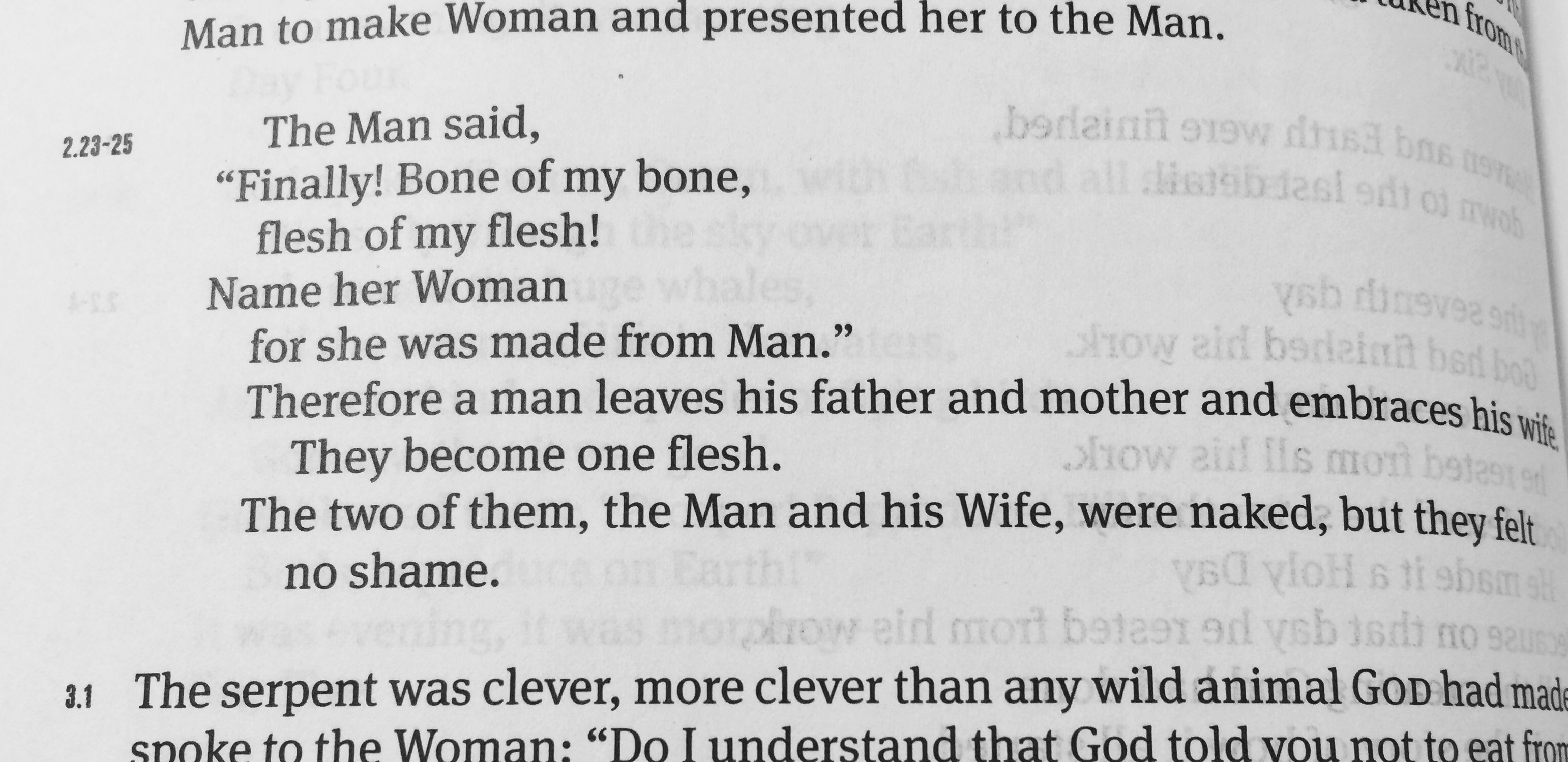
“The two of them, the Man and his Wife, were naked, but they felt no shame.
The serpent was clever, more clever than any wild animal God had made.” Genesis 2:25-3:1.
You can see how it looks in the book in this photograph.
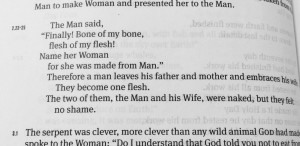
Uninterrupted by a sectional heading, the two sentences convey more fully the tragic loss of Adam and Eve’s sin. Before the Fall, the first couple were united and shame-free; the clever serpent, as we read in the next few sentences, seduces them to sin. The Adam and Eve we meet in verses 7 – 13 are shamed and shaming, divided from one another and from God.
- New observations. Ordinarily, I read Job thinking I already know the story. This time, in addition to noticing the vibrancy of the various characters and the relevance of their skewed theologies for today’s world, I noticed something else – the vast numbers and varieties of animals. I scribbled in the margin: “The Nat-Geo of the Bible.”
- Wonderful possibilities. The structure and the language do make this Bible truly readable. As a teacher who loves to help people learn, live, and love the gospel story, I see many exciting possibilities for The Message 100. Here are two:
- Use the book for a Book Club type study, perhaps having people read 3 to 5 readings a week and gathering to discuss. It would be a great outreach Bible study (Such a study may be coming online to Living Story – let me know if you would be interested!)
- Read the whole Bible straight through. I don’t mind saying I’m often intimidated by Read-the-Bible-in-a-Year plans. But I think I could read The Message 100 in less than a year, if I add it to my stack of currently-reading books (I usually have 3 going at a time, plus one fiction for bedtimeJ).
Cons of The Message 100
You can probably tell that I’m pretty excited about this Bible.
- A caveat more than a con. It is not a literal translation. The Message Bible, as its writer acknowledges, is not a literal translation of the Bible. That being said, Eugene Peterson is a biblical languages scholar who made his dynamic equivalent/paraphrase by translating the original languages.
I am always saddened by the number of people who disdain The Message without knowing Peterson’s scholarship or understanding his true intent:
“my intent here…is simply to get people reading it who don’t know that the Bible is read-able at all, at least by them, and to get people who long ago lost interest in the Bible to read it again” (from the Preface to The Message).
He goes on to say that people should get a study Bible to help with further study.
- Thin Paper.I know it’s not politically correct in this eco-friendly world to complain about paper – I probably should have the book on Kindle. But I am a bibliophile, and I like books I can touch, especially the Bible. The review edition of The Message 100 I was given is a very thick paperback with very thin pages. I’m guessing it was made this way to make it seem more like a paperback novel, less formal and stiff-looking as a typical Bible, and I get that. But personally, I’d like to see a heftier edition. (As it turns out, there is a hardback edition. I don’t know if its paper is heavier:-)!
My conclusions:
I give The Message 100 a huge thumbs-up as a wonderful new resource for engaging the whole story of redemption the Bible tells. It is easy to read, and it draws people more deeply into the story. It opens our eyes to the wonder of who God is and the magnitude of what He has done through Christ. Reading The Message 100 will help us learn, live, and love in the one true story that makes sense of life – the gospel!
Sign up now to receive Living Story blog in your inbox once or twice a week!
Acknowledgment in my own words: The publisher gave me this book for free and asked me to review it. I was not paid, and I was not required to write a positive review. These opinions are mine:-)!
Or…the legalese version:
I received this book free from the publisher. I was not required to write a positive review and the opinions I have expressed are my own. I am disclosing this in accordance with the Federal Trade Commission’s 16 CFR, Part 255 : “Guides Concerning the Use of Endorsements and Testimonials in Advertising.”