Freedom from Parenting Guilt: Six Gospel Keys

Freedom from Parenting Guilt: Six Gospel Keys

Freedom from Guilt about Parenting Programs

The toddler is screaming for those mini-Oreos in the cookie aisle. If you know exactly what to do, you may not be a parent. The fact is, parenting is confusing—the right thing to do is not always clear.

The Living Story focus for July is freedom, specifically the freedom we enjoy in Christ. Because too many parents spend their lives trapped in guilt, today we are focusing on freedom from parental guilt. If you know a parent who needs freedom and hope, please share this post with them.

From the time we are pregnant or adopting, we will be met with parenting advice and programs. Some parenting programs hold false promise to help us produce the designer child we think we want. Child-centered, parent-centered, Jesus-centered—which do we choose? (We DO know the Sunday school answer)!. And even if we know which program is right, how do we execute?

Some parenting programs hold false promise to help us produce the designer child we think we want. #gospelcenteredparentingCLICK TO TWEET

The Only Parenting Program That Frees us from Parental Guilt

The truth is, no program will “work,” whatever that means—not even the Jesus-centered one. Not because Jesus fails, but because we do. Please don’t hear what I’m not saying: the collective, common-grace wisdom of these programs can be very helpful, or why would I have hauled around that heavy tome, What to Expect When You’re Expecting throughout my pregnancy?

We, and our children, will fail to keep the law every time. We need Holy Spirit help.CLICK TO TWEET

We and our children will fail to keep the law every time. Thankfully, God’s gracious, compassionate, unchangeable, eternal plans never fail. And his Spirit empowers us to live for him. In God’s parenting program, there is freedom and hope for parents and children alike.

Six Gospel Keys to Freedom from Parental Guilt

1.   Learn the redemption story Scripture tells.

Isn’t that a fancy way of saying “Read your Bible”? Why, yes, yes it is. But it’s even better than that. The Holy Spirit actually transforms our hearts as we read. So, let’s listen to Romans 12:2:

“Do not be conformed to this world, but be transformed by the renewal of your mind, that by testing you may discern what is the will of God, what is good and acceptable and perfect.”

2.  Pray. Over and Over. Often. Believing that God hears (1 Thessalonians 5:17).

  • When you don’t know which school will help your son with his learning disorder, ask God to show you the way and remind you that he really does have a plan.
  • Ask God for your daughter’s shoulder to heal so she can play college volleyball. If it doesn’t, ask him to give you a bigger picture of the redemption story you are writing in her life.

3.  Repent.

“Repent, then, and turn to God, so that your sins may be wiped out, that times of refreshing may come from the Lord” (Acts 3:19).

  • Drive back to the school with a smiley-face cookie for the boy you left with a harsh word.
  • Call your twenty-year-old and tell her you’re sorry for trying to write her story your way.
  • Admit that parenting does not preclude sinning against your children, and turn back to your Savior for forgiveness.

4.  Forgive.

“As the Lord has forgiven you, so you also must forgive” (Col. 3:13).

  • When the three-year-old tells you he hates you, forgive him.
  • When your previously compliant teenager starts rolling her eyes at everything you suggest, forgive her.

Forgive them, not with your arms folded and a begrudging frown, but as your Father forgives you, tenderly, compassionately, mercifully, with open arms. (Of course, forgiving does not mean excusing! Yes, there are consequences to sin, but we are called to forgive as our Father forgives).

5. Work as a team with your spouse, ex-spouse, and other caregivers.

  • When your husband uses the Shop-vac to clean up a toddler’s vomit while you are at the church retreat, praise his ingenuity!
  • When you bitterly disagree about how to address addiction to video games or addiction to drugs, look to Christ as your reconciler.

At times, it will take hefty doses of humility to live in unity with other caregivers; Christ has shown us the way.

6. Surround yourself with grace-filled community.

  • Make friends who will hit their knees when you call to say your daughter has binged again, or your son has been diagnosed with lymphoma.
  • Thank your children’s hard-working teachers for seeing that your child needs structure and leadership opportunities to keep her explosive energy moving in the right direction.

A Prayer for Guilty Parents

Lord, help us. We need to know the freedom we have in Christ, that we are forgiven for our sins against our children. Please take this burden of guilt we carry, and leave us with the joyful “yoke” of serving you as parents. In Jesus’ perfectly loving name we pray, Amen.
Freedom from Racial Brokenness: 5 Black Female Voices

Freedom from Racial Brokenness: 5 Black Female Voices


Is it even possible to be freed from racial brokenness? Is there hope for healing? Listen to five female black voices writing about the brokenness as well as the true hope for healing. With Vanessa K. Hawkins, Lisa Robinson Spencer, Jasmine Holmes, Trillia Newbell, and Jackie Hill Perry.

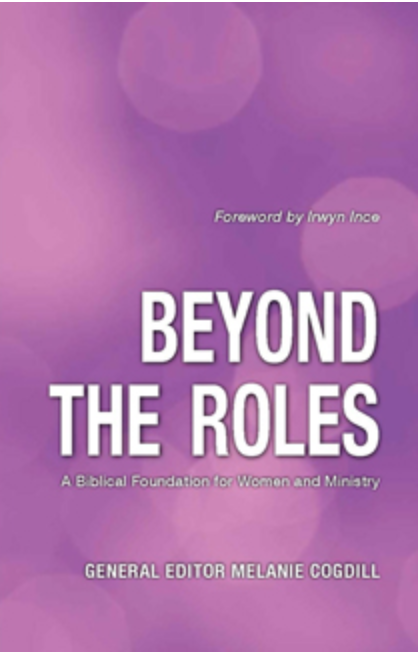
Beyond the Roles

Vanessa K. Hawkins

(MDiv, Covenant Theological Seminary) Director of Women’s Ministry at First Presbyterian Church in Augusta, Georgia. Women’s Ministry as Diversity Adviser, PCA.


Vanessa K. Hawkins, From her article “On Oneness, Lament, and Seeing with Compassion” at the EnCourage blog:

“Looking Isn’t Always Seeing

While it is necessary to look in order to see, looking doesn’t always equate to seeing. Movement from blindness to sight is a metaphor used repeatedly in Scripture to talk about our inability to fully see. “For now we see in a mirror dimly…” (1 Cor 13:12). While we don’t see perfectly, it doesn’t mean that we can’t see or shouldn’t try to see to the best of our ability. Spiritual sight is Spirit-dependent and is part of our growing in the likeness of Christ.

Most of us would openly and wisely admit that we have blind spots, and that’s great awareness to have. But to know we have blind spots and not seek to overcome them is reckless at best. Having blind spots is not a neutral state but dangerous to the one you can’t see. The inability to see is not a matter of if I injure someone, but when.

This is also true for colorblindness. I have heard well-meaning people claim colorblindness as a way of communicating their refusal to discriminate based on skin color. While not discriminating is a noble idea, colorblindness is a sight problem. To not see color is to not fully see those endowed with beautiful melanin by a Creator who calls what He made very good (Genesis 1:31).  To not see color is to deny the race-based, systemic ills that snuffed out the lives of Ahmaud Arbery, Breonna Taylor, George Floyd, and way too many others to name. The Father isn’t colorblind. He celebrates and redeems our ethnic differences (Rev. 7:9).

Good vision affords us the ability to see and celebrate our ethnic differences, not just tolerate them and certainly not despise them. Colorblindness is not a virtue; it’s dysfunction. Scripture calls us from blindness to sight. Our cry should be that the Lord help us see and move us from blindness to sight.”

Jasmine Holmes

Teacher, Author

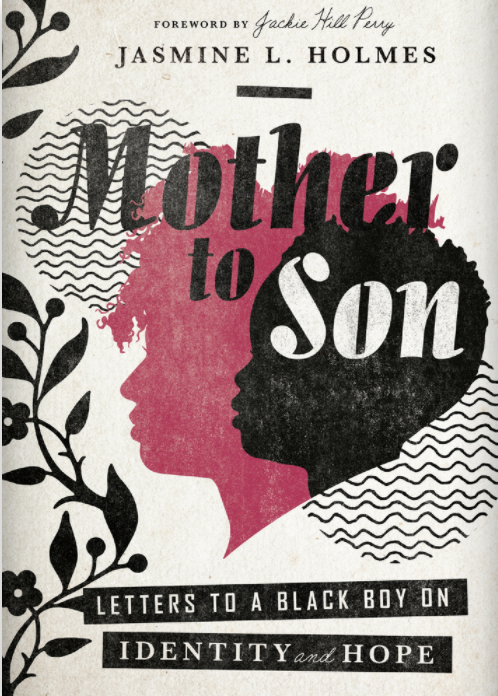
Mother to Son: Letters to a Black Boy on Identity and Hope

Mother to Son by Jasmine Holmes

From Mother to Son:

“I set out to write a series of letters to Wynn, not just about the racial climate of the country that he lives in, but about the conversation surrounding this racial climate. I want to remind him that his identity is firmly planted in the person and work of Christ Jesus and that because of that he has incredible significance to the King of the universe. I want to remind him of his dignity as an image bearer and to encourage him to respond out of that dignity, even to a topic as emotionally charged as racial reconciliation. Even when the topic concerns the brown skin that he lives in.

But more than that, I want these letters to be a testament of a mother’s love for her son and of a sister’s love for the body of Christ. Because when I speak about these topics, I want to hold my brothers and sisters in the Lord close to my heart, as I do my own son—my own flesh and blood. They are my blood-bought family in Christ, redeemed by the God who took on flesh to save them.”

Beyond the Roles

Lisa Robinson Spencer

(ThM DTS), Executive Director of Local Colors

From Lisa’s article

Some thoughts on the church and racial reconciliation efforts

So when we talk about racial reconciliation efforts–whether it be a panel discussion, workshop, books, blog posts, the goal should be to create a more harmonious Christian fellowship that is centered in the work and person of Jesus Christ. I can honestly say that I’ve seen this at work in healthy and productive ways. When racial reconciliation efforts starting rising in the evangelical scene, this is what it was intended to be. As someone who has been invited to speak and write on these issues, have attended events where racial reconciliation something to be tackled, and engaged in numerous conversations, I am staunchly committed to keeping this goal so that Christ’s body is strengthened. Jesus broke down the walls of hostility but in our embodied experiences, we need to bring this truth to life for hostility that has been created.


Trillia Newbell

Acquisitions Editor at Moody Publishers

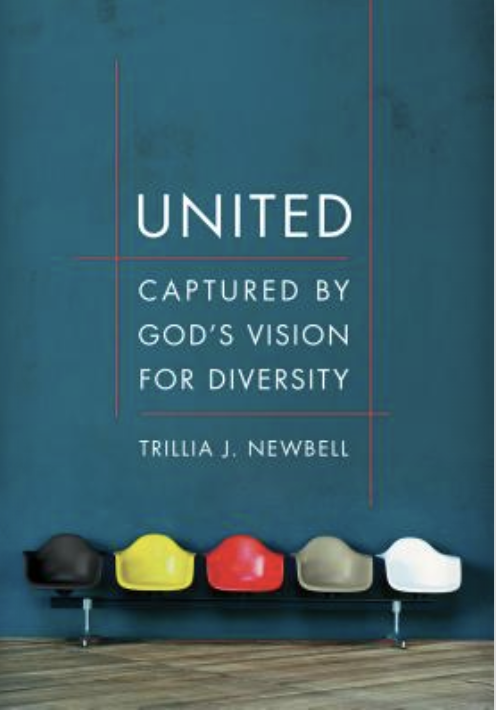
Author: United: Captured by God’s Vision for Diversity

Cover: United by Trillia Newbell

From United: Captured by God’s Vision for Diversity

“Perhaps it seems that the country is moving toward unity, but it’s a façade—just check your local news. And though our society may want to move on, we can’t, and neither can or should the church. Maybe our churches remain segregated simply because it’s comfortable with “our own.” (You won’t get far in this book before you’ll see that I believe ‘our own’ needs a new definition.)

But maybe it’s because diversity and racial issues are scary. Talking about race and racial reconciliation can be downright terrifying. No one wants to offend, and in our politically correct society, who would blame you? If you say the wrong thing, ask the wrong question, or call someone by the wrong name, will they be angry? Are you black or African-American? Chinese or Asian? Hispanic, Latino, or Mexican? This is an explosive topic, and sometimes it seems that the wisest course of action is to avoid it at all costs.

There is a richness in knowing—really knowing—someone who is different from you. I bet you have (or have had) a relationship in your life that confirms the truth of this. God thought it important to let us know in His Word that every tribe and tongue and nation would be present on the last day, worshiping together. Shouldn’t we desire to reflect the last day before He returns?”


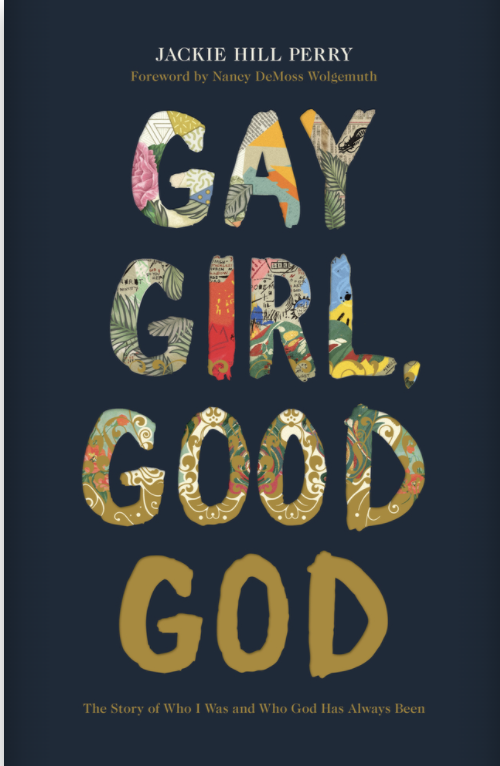
Cover:Gay Girl, Good God

Jackie Hill-Perry,

Poet, Hip-Hop Artist, Author

Gay Girl: Good God

From Jackie’s article on “Gospel Diversity for the Next Generation” at The Gospel Coalition

“Show them what it looks like to be a peculiar people that belong to God. We don’t really belong to this country. We don’t really belong to a political party. We don’t belong even to our economic status. Heck, we don’t belong to this world. We are a people for his own possession.

And that’s what God has done. The next generation would follow in our footsteps and then they would come to realize that as they did, they were actually following Jesus, and not a God made in America’s image. They would come to see that as you set your mind on things above where Christ, he is seated at the right hand of God, the place he went after he did what was just and right, the seat he sat down on after dying and raising on behalf of people, that he died [to purchase] for himself [a people] from every tribe, tongue and nation. They would see that because you set your mind up there where he is, that they can, too.

When we set our eyes on Christ instead of setting our eyes on our fathers’ idols and everything else that keeps us from gospel diversity, you can be sure that is when we begin equipping the next generation for gospel diversity.”

Get Five Freedom Verse Cards or Wallpapers

Join Living Story Subscribers to get free gospel-centered resources every month.

A Good Read for Hard Times: The Waiting Room Devotional

5 Verses on True Freedom

Five Verses on True Freedom


In these turbulent times, we need to know more than ever the freedom we enjoy in Christ. In Christ, we are…

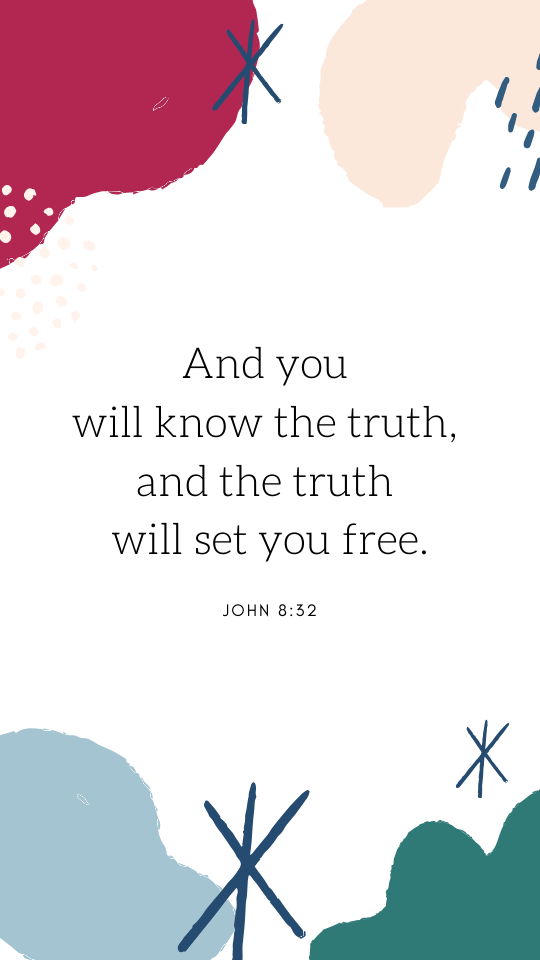
Bible verse: And you will know the truth, and the truth will set you free.

Freed by the Truth

To be who Christ has designed us to be.

John 8:32

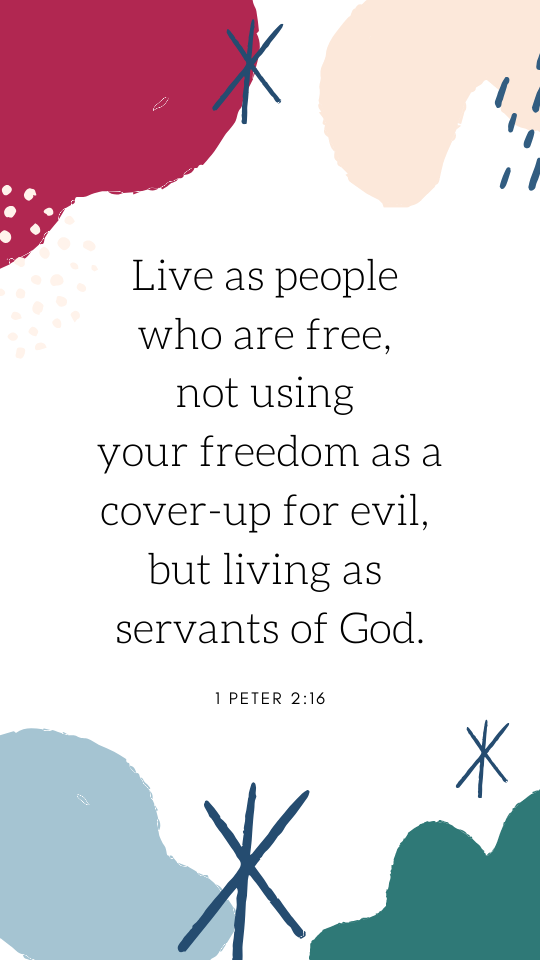
Freed to Serve Others

Not freed to “do evil.”

1 Peter 2:16

1 Peter 2:16 Bible verse graphic
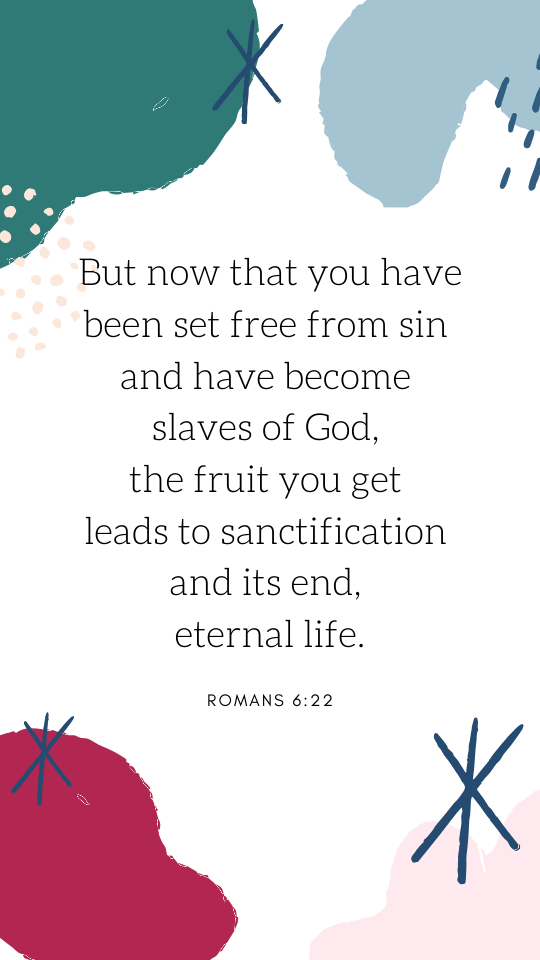
Graphic of Romans 6:22

Freed from Guilt

No longer slaves to sin, freed to love and obey God.

Romans 6:22

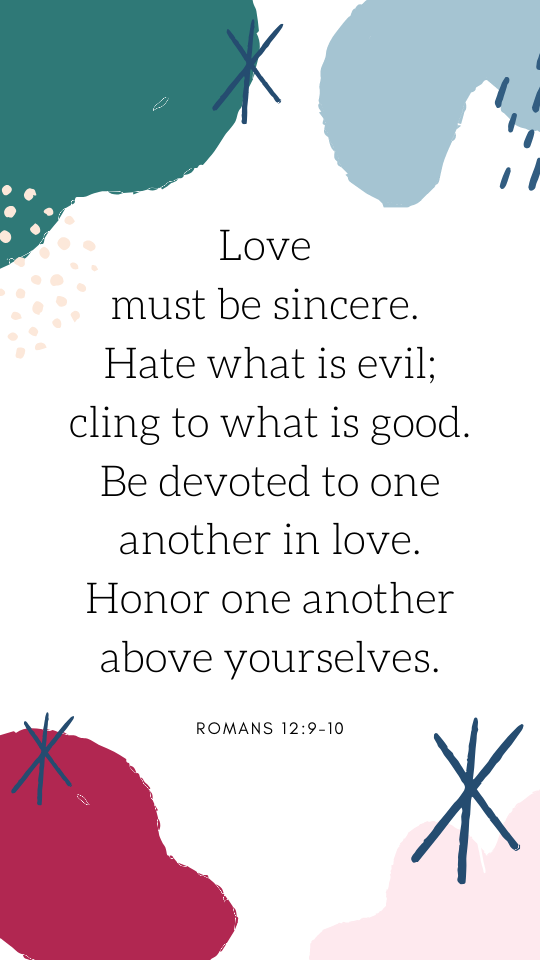
Freed to Love Others Radically

To hate injustice and sin and to practice hospitality.

Romans 12:9-10

Graphic of Romans 12:9-10
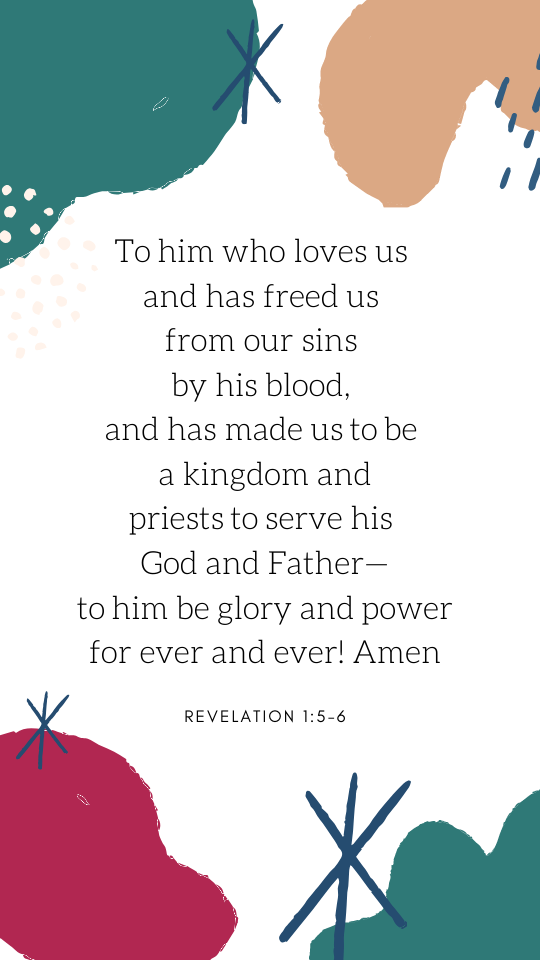
Graphic of Revelation 1:5-6 Bible verse

Freed to Give Glory to God

To serve as priests in his kingdom

Revelation 1:5-6

Get a new free gospel-centered resource every month!

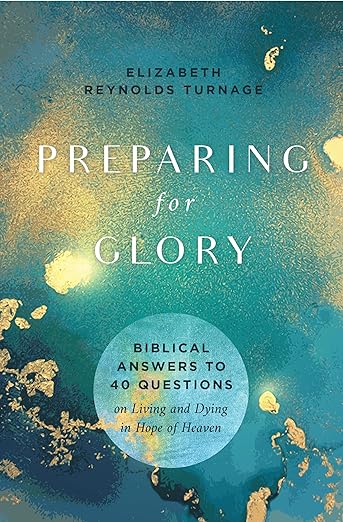
A Good Read for Hard Times: The Waiting Room Devotional

A New Woman’s Story

A New Woman’s Story

A New Woman’s Story for International Women’s Day

What’s new? As March begins, we’ll be considering the theme of “new” things, and today, in honor of International Women’s Day (March 8), I’m going to tell about a new – very old – way of understanding a woman’s story. It is new because it challenges many of the current understandings of a woman’s story. It is old because it is the first story ever told about women.

Let’s look at the structure of the Biblical story to see how God has written a woman’s story.

1.  Creation (Gen. 1:26-31; Gen. 2:18-23). Women were created with dignity and purpose for God’s glory.

  • God created women with dignity, differentiation, and dominion. God created women alongside men to join together in praise and purpose.
  • If you are a woman, you, together with man, are created in the image of God – you reflect God’s glory.
  • God created women different from men, described in Hebrew as  “ezer kenegdo” (Gen. 2:18), which literally means “helpers as corresponding to” a man. (To give you an idea of the strength implied by the word “ezer,” take note that the word is used mainly to refer to God in Scripture).
  • Women, with men, have a crucial mission, summarized in the mandate, “be fruitful and multiply and have dominion over the earth.” While being fruitful and multiplying does refer to childbirth, it also refers to multiplying God’s majesty on earth. Women can be fruitful and multiply as scientists, missionaries, housecleaners, firefighters, mothers, and wives, among many other things.

2.                  Fall (Gen. 3:1-19). Women are sinners who have fallen short of the glory of God (Rom. 3:23).

  • Women sin. (Men are complicit in woman’s sin when they fail to speak into their lives and lead as God instructed (Gen. 3:6)). Women (like men) are easily seduced by things that seem pleasing to the eye, things that promise to give us the control we desperately want, things that we think will crown us the Queen of our Own Universe.
  • Women feel shame (as do men). Women feel shame over their sin and want to hide from God (Gen. 3:7).
  • Because of the Fall, women also at times experience shame for sins perpetrated by others; emotional, physical, or sexual abuse cause deep wounds.
  • Women suffer from a curse – physical and emotional pain in our bodies, relational pain resulting from loneliness, and the temptation to control and manipulate the men in our lives (Gen. 3:16).

3.                  Redemption (Gen. 3:8-9; 2 Cor. 5:17-21). God has redeemed women and freed us to live our stories for his glory.

  • God pursues women (and men) in our sin. He goes looking for us in hiding, even when he already knows where we are (Gen. 3: 8-9).
  • God dignified a woman with the mission of bearing the offspring that will defeat the evil one once and for all (Gen. 3:15; Matthew 1:18).
  • He covers our shame, both with clothing (Gen.3:21), and through a Savior who will die for our sins and cover us with his righteousness (2 Cor. 5: 21).
  • When women realize our own works are rubbish (as are men’s) (Phil. 3:8) and turn to Christ as our only Savior (repentance and faith), we are freed from the shame that has defined us. No longer “not enough,” we are made “more than enough” in Christ.
  • Redeemed women now live for Christ as new creation – yes, struggling with sin until the day he returns (Romans 7:18-19), but nonetheless new and becoming more like him every day (1 John 3:2).

4.                  Consummation (Rev. 21-22). God will one day fully restore a woman’s peace, and we will rest and enjoy his honor, glory, and love.

  • One day, Christ will return to claim the church as his bride (Rev. 21:2). God will be with women and men, and he will wipe every tear from our eyes (Rev. 21:3-5).
  • At the end of the story, when sanctification is completed in glorification, we will begin a new and unending story of living as we were created to live (Rev. 21:5). Women and men will no longer be divided; no longer will we suffer from our own selfish demands. We won’t murder our friends or family with mean words. We won’t be tired by our exhaustive efforts to please people; we won’t be torn by our desire to be known and our fear of being known.
  • We will love to be loved and we will love to love.

A Prayer for a Woman’s Story

On this week leading up to International Women’s Day, let’s take time to pray for the women of the world and the women in our lives.

Creator God,

We thank you for the way you created the first woman, Eve, and endowed all women with strength and dignity, dominion and purpose. We are glad you made women and men different; we praise you for creating male and female in your image.

Women: Forgive us for the harm we have done as women — seeking our own way, trying to manipulate and control our worlds, grasping for power that was meant for You alone.

Men: Forgive us for the harm we have done as men — misusing authority to oppress and suppress women, failing to honor the wisdom and unique insight of women, and even demeaning women by treating them as our objects rather than Your subjects.

Thank you that you are redeeming and renewing us as women and men day by day. Thank you for writing a new story in a woman’s heart, for freeing us from slavery and clothing us with your righteousness. Thank you for creating us anew and giving us a fresh vision for who you have called us to be!

We pray for restoration for all of the women of the world. We lift up especially women who are abused and trafficked, women who do not have equal opportunities for education, women who are treated in ways Jesus never would have treated them. Bring hope to the dark places of women’s lives. Come Lord Jesus, come soon, to complete your renewing and reconciling work among all the women of the world.

In the name of the Savior who loved women perfectly we pray,
Amen.


Photo by Priscilla Du Preez on Unsplash

Parenting Goals: Should We Have Them?

Parenting Goals: Should We Have Them?

Parenting Goals: What do you think?

Do you think parents should have goals and plans? If so, what kind?

When I venture to write about parenting, I always do so tremulously. Yes, I am the mother of four adult children, ages 30 to 24, mother-in-law to three. And yes, they are pretty awesome kids. But my husband and I (and my children, I’m sure) agree—their awesomeness is not the product of our parenting expertise, of which we have some, but not enough. They have grown and matured and become the wondrous creatures they are only by the grace of God.

That being said, even as God has grown our children, he has redeemed and matured us as parents over the past thirty years. Since this month’s blog theme is Planning and Goals, I decided to revisit our parenting goals or lack thereof.

The Early Years: My Top 5 Unstated Parenting Goals

The truth is, I’ve never been much on writing down my parenting goals. I think we may have done it once when our eldest was a colicky six-month-old, when the gracious grandparents offered to keep him so we could go to a Family Life conference. I think there was a workbook, and I think there was a place for parenting goals? (As you can see, the postpartum amnestic effect took its toll!).

By the time our second child came along twenty-one months later, I had neither time nor energy to write formal parenting goals. That is not to say that I didn’t, at some level, have them. So here it is…

My Previously Unstated Parenting Goals

  1. To survive.
  2. To have the ideal family.
  3. To win the “mother-of-the-year” award.
  4. To raise kids just like us.
  5. To “just get them out.” (All four of my children were 8-14 days overdue;-)!

As my children grew, and as God grew me, I believe some truer goals/desires/prayers emerged, although again, I don’t recall writing them down.

The Later Years: My Top Five List of Mostly Unstated Parenting Goals

  1. Remember that God loves me even when I’m a “failure” as a mom.

Before I became a mom, I taught English to junior high and high school students. I loved teaching, and I was mostly good at it (according to my superiors, students, and [most of] their parents). When I brought that first baby home, my competence and confidence evaporated. (Maybe I pushed them out along with the baby in my 33-hour Pitocin-induction labor?)

Some of my parenting ‘fails’ make me laugh now. I didn’t know what happened when you changed a boys’ diaper. One time a second-grade teacher sent me a note requesting that I pack a peanut butter and jelly sandwich in my child’s lunch instead of peanut butter and crackers (This was in the days when peanut butter was not verboten.) And so on.

Although my parenting ‘fails’ make me laugh, my parenting sins make me weep. I lost my temper, I yelled, I guilted them, and I whined. And that’s just the beginning. Frequently. It hurt. Them and me. I wanted to be a perfect mom—always kind and patient and nurturing. Hope came as I learned I could not make God love me less. Rest came as I trusted in Christ’s righteousness, not my performance as the core of my identity.

Do you know what your unstated goals of parenting are? Here were some of mine. #parenting Share on X

  1. Ask forgiveness. Repent quickly.

This second goal is a corollary to the first.

I’m not sure how any parent survives the guilt and shame of failing our children if we do not believe that Christ freed us from our sins and God has forgiven us in Christ.

So I learned to say I was sorry. To God and to my children. I didn’t/don’t always go quickly, but I usually went/go. I learned to ask forgiveness for – fill-in-the-blank: speaking too quickly, humiliating them, not listening to them…the list goes on. I learned to ask God to change my heart.

To this day, my husband and I believe that asking forgiveness and repenting are the most important habits we developed as parents.

  1. Pray for me as a mom, pray for them as kids.

I didn’t know this till I became a parent, but I quickly realized that many questions in parenting don’t have clear answers. Not only are we often confused as parents, we are also frequently powerless.

I quickly realized that many questions in parenting didn't have clear answers Share on X

Do we let them cry at night or pick them up and feed them? What do I do when my child is bullied on the playground? How do I punish my teen for breaking curfew to help a friend? And on and on. Sometimes there are practical answers, and it often helps to seek wise counsel, but the first and last and in-between thing to do is pray.

  1. Help them live their stories for God’s glory.

It took us way too long to realize this. For many years we tried to get our kids to live the story we had written for them (see above). Over time, though, we learned and are learning to honor the individuals God has created them to be. We ask God to show us how to support and encourage them in living out that story for God’s glory—not for ours!!!

  1. Teach them, “Be kind to one another” (Ephesians 4:32).

This was one of the few parenting goals that I think I might have written down. I know I knew it by heart. It was my go-to, my default. It was the motto I wanted my kids to live by, so much so that I have been known during sibling bickering to raise my voice many octaves and command: “Be kind to one another!”

Parenting Goals, Yes or No?

In writing this blog, I discovered that I have had and do have a mission in mind—“Be kind to one another, forgiving one another, just as in Christ, God forgave you.” That mission in many ways guided my goals, which I think I did write down—as prayers: “Lord, help me to help [insert child’s name] in her struggle with organic chemistry” (I totally made that one up). There was and is an intentionality to my mothering, and I did take specific actions to reach my often-unstated parenting goals.

A Prayer about Parenting Goals

Dear God, you are such a good Father. Thank you for forgiving us our parenting sins and for helping us get over our parenting fails. You indeed have parenting goals for us, to grow us to be mature and complete, to live for your glory, and to bless others with the riches of Christ. Help us as parents to set good goals for our family: to learn, live, and love in your story of grace. In Christ’s kind name we ask, Amen.

What about you? Do you write goals for parenting? Do you have a family mission statement? What steps would you like to take to be more intentional about your parenting?


Photo by Priscilla Du Preez on Unsplash

5 Story Questions for the New Year

5 Story Questions for the New Year

Does the new year seem like old news to you by now?

We have long since toasted the new year with champagne or fizzy grape juice, watched a ball or bird drop somewhere, and cheered (or yelled) ourselves hoarse over now-nearly-forgotten football games. We’ve eaten our collards, pork, and black-eyed peas, made our resolutions, and already broken many, if not all of them.

I resist making resolutions, because for me, they usually mean “things I will accomplish through my determined will and human effort,” and that’s a complete setup for disaster. Instead, I think about stories.

Why we should mark our stories in the new year:

This time of year is a great one for marking our stories, remembering where we have been, thinking about where we are now, and considering where we are going. As we view what God has done in our lives through the year(s), some general themes start to emerge. We remember our purpose and calling, one of which is as The Message puts it, “Go after love as if your life depended on it, because it does.” (I Cor. 14:1).

Consider these five questions as this chapter of a new year begins:

  1. What events have happened in my life and in my heart in the last year? What tragedy and/or redemption do I see?
  2. Where am I now? Think emotionally, spiritually, circumstantially.
  3. What might God have for me in the coming year or years? What new freedoms in Christ might I experience?
  4. Who are the people who will support and encourage me as I step into these hopes and dreams?
  5. How must I depend on the Holy Spirit to act in grace? How may God be glorified?

I’d love to hear how you answer some of these questions. Please share them in the comments or join me on my Facebook page, Elizabeth Reynolds Turnage, Author, for discussion.

A Prayer about Living in God’s Story of Grace

Lord, you know our hearts inside and out. You designed us for your glory even before we were born. In your son, Jesus, you have re-created us to do good works (Eph. 2:10). By your Spirit, we ask you to reveal your plan for us and empower us to “go after love as if our life depended on it” (1 Cor. 14:1, MSG). Amen.