
A New Series on Aging, Dying, and Death

A New Series on Aging, Dying, and Death

A New Monthly Blog on Aging, Death, and Dying

Hi Friends,

Today begins a new monthly series on aging, dying, and death. Please don’t click away. 

Did you know that the fastest growing age group in America right now is 85 and older, and the “current growth of…65 and over is unprecedented” (PRB.org)? Even if we are not aging, dying, or dead, we need to recognize the inevitable reality. And if we are, especially if we are Christians, there is much to be gained and little to be lost by knowing the hope of the gospel for this season of life. I hope you will walk this journey with me. I hope you will share your stories, your thoughts, your questions, your prayers. Please feel free to email me using the contact form or by commenting below. I promise I will get back to you. 

Why We Don’t Talk about It

I don’t mean to be morbid, but I’m dying. I don’t mean to be offensive, but so are you. Despite a myriad of life-prolonging advances in modern medicine, the mortality rate remains at 100%. If I continue to live, I will get old (something our world may consider worse than dying), and if I don’t, well then, I will die. 

Despite the certainty of death, it seems no one really wants to talk about it. Just last month, I had the privilege of taking part in a well-designed and lovingly-executed conference on The Practical Theology of Death and Dying. (My part was to offer a workshop for caregivers.) At this vibrant church known for its well-attended events designed to help people apply the gospel to daily life, the attendance was, unsurprisingly, lower than usual. 

We don’t really have to wonder why. At some level, it’s obvious. It’s morbid (a word that did not used to carry the negative connotation it now does) to talk about death. In our anti-aging society, the subject has become taboo. We can watch traumatic deaths on cable news or bizarre deaths on crime shows, but we can’t talk about the realities of aging, dying, and death.

Why Christians Can Talk about It

And yet, as Christians, the cultural narrative doesn’t, or shouldn’t, define us. We might well ask why Christians are so reticent to discuss the issues of aging, dying, and death. The Bible doesn’t shy away from talking about death. Christians in previous centuries were intentional about preparing for death: pastors preached sermons on death, and tracts were written to help people with the “art of dying” (ars moriendi). 

In his eloquent liturgy that opens his book Every Moment Holy, Volume II: Death, Grief, and Hope (affiliate link), Douglas McKelvey articulates a warm invitation to speak of death, dying, grief, and hope:

“Children of the Living God,

Let us now speak of dying, 

and let us speak without fear, 

for we have already died with Christ, 

and our lives are not our own. 

Our dying is part of the story 

that God is telling to us, 

and part of the story 

God is telling through us…. 

Death will not have the final word, 

so we need not fear to speak of it. 

Death is not a period that ends a sentence. 

It is but a comma, 

a brief pause before the fuller thought 

unfolds into eternal life.  

Douglas McKelvey, “An Exhortation Making Space to Speak of Dying.”

McKelvey is right—we can talk about death and dying. We can talk about aging. We can face the hard and bitter realities—dying sucks the life out of us and aging subjects us to previously unimagined levels of indignity—because God is telling a story of hope to us and through us as we age and die. Aging and dying, while they can bring new levels of indignity and humiliation, can also bring new levels of surrender and growth, not to mention the perspective and wisdom to bless both the dying and the living. When we not only talk about aging and dying and death but face it intentionally and prepare for it, we can know deeper joy, peace, and hope. 

Next month, we will discuss the benefits of discussing and preparing for aging, dying, and death. For today, I’ll leave you with a few reflection or discussion questions. I’d love to hear your thoughts on these or anything else that comes to mind about these hard topics:

For Reflection:

1. How do you feel about discussing aging, dying, and death?

2. Have you known anyone who prepared well for their death? How did that bless you? Conversely, have you known or observed someone who did not prepare well? How did that affect their loved ones?
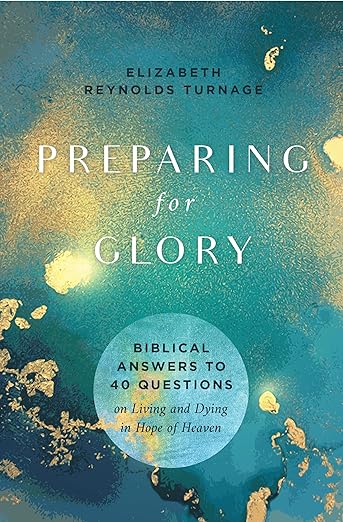
For A Prayer about Discussing Aging, Dying, and Death, go here.

A Prayer about Radically Good News

A Prayer about Radically Good News

Lord,

On this Monday, draw us to your Word to pray with Paul,

to pray for those we love and those we need to love, 

that the “truth of the Good News” about Jesus Christ 

would radically change the way we live.

By your Holy Spirit, may the Good News 

give us a stunning love for others (Colossians 1:7).

By your Holy Spirit, may the Good News 

give us “spiritual wisdom and understanding” 

and a “complete knowledge of God’s will” (Colossians 1:9).

By your Holy Spirit, may the Good News 

lead us to “honor and please the Lord” 

and to “produce every kind of good fruit” (Colossians 1:10).

By your Holy Spirit, 

may this Good News “strengthen us with all his glorious power” 

so we “will have all the endurance and patience” we need. 

Finally, by your Holy Spirit, 

may the Good News 

fill us “with joy,” today and every day of this week, 

and may we be found “thanking the Father,” 

whatever our circumstances (Colossians 1:11-12). 

In Jesus’ supreme name. Amen.

Read Colossians 1:1-12.

A Prayer about a Love like No Other

A Prayer about a Love like No Other

Ever-loving Father,

Wow us with this amazing news today! 

You have called us your children, 

and we really have become your children. 

Do we realize that this changes everything? 

Yes, it’s true, the world cannot understand 

why we spend half our Sundays at church worshiping you, 

because they can’t see that it’s a family reunion, 

that we are all gathered together as your children 

(and that we actually kind of get along even when we don’t) 

because you first loved us, 

and we want to tell you how much we love you (see 1 John 3:1; 4:19).

Even more amazingly, 

not only did you love us 

and adopt us as your children 

and give us an amazing inheritance, 

you are growing us up to be just like Jesus: 

“…but we know that when he appears we shall be like him, 

because we shall see him as he is” (1 John 3:2).

Oh Lord, multiply our joy today with this good news!

Oh Lord, hasten the day when we see our Savior 

and become like him.

In Jesus’ transforming name. Amen. 

Read 1 John 3:1-2; 4:7-19.

A Prayer about Weakness

A Prayer about Weakness

Lord,

I confess, I don’t like being weak at all. 

You say that weakness is the Christian’s way, 

but I was born and raised in America, 

by strong people who taught me to work hard and be tough. 

Not only that, but I’m afraid much of what I’ve observed in church 

suggests that we should be strong as steel and stoic as statues. 

And yet, you say that the way to be strong is to be weak. 

You say you will make us into people 

who are “content with weaknesses, insults, 

hardships, persecutions, and calamities” (2 Corinthians 12:10). 

Help us, by your grace, to grasp the paradox. 

May we cling to our crucified Savior, 

who though he was God, 

took on the weakness of human flesh. 

Wrap us in the strong embrace of our risen and ascended Savior, 

who for the joy of making us your children endured the shame of the cross.

Send us into the world, 

weak and frail as we are, 

to invite others to join us 

in the only weakness that could ever strengthen us.

In Jesus’ strong name. Amen.

Read 2 Corinthians 12:1-10.

A Prayer about Not Worrying

A Prayer about Not Worrying

Good Father,

Once, after a hurricane, 

a friend told me how she handled her worry 

that her seventy-year-old house 

would be destroyed: 

“I stayed inside and thought happy thoughts.” 

There’s nothing wrong with thinking happy thoughts, 

but you have given us a much better antidote to the worry and fear 

that plague us during seasons of crisis: 

Prayer. 

Rejoicing in you, 

because that turns our thoughts 

toward your delight in us and our hope in that delight (Philippians 4:4).

Presenting our requests to you, 

because that acknowledges our utter helplessness, 

your supreme power,

and your good, Fatherly care for us (Philippians 4:6).

Thanking you, because that reminds us 

of how you have saved us in the past 

and points us toward 

how you will rescue us in the future (Philippians 4:6).

Lord, today, when worry creeps in, 

turn our hearts toward you in prayer, 

that we may know the peace 

that surpasses all understanding (Philippians 4:7).

In Jesus’ peace-bringing name.

Amen.

Read Philippians 4:4-9.