A Prayer about Seeing My Own Sin and God’s Grace

A Prayer about Seeing My Own Sin and God’s Grace

Merciful Lord,

It’s impossible to read the list of sins 

describing people who don’t “see fit to acknowledge God,” 

and not see ourselves somewhere in it—

have I ever gossiped, 

speaking ill of people behind their backs? 

Have I ever been boastful and haughty, 

thinking I know the right thing to do 

about raising children, 

protecting from disease, 

or even teaching Bible study? 

Was I ever disobedient to my parents as a teenager? 

Have I ever wanted to possess what someone else has? 

Have I ever not only done these things 

but given approval to others who do them (Romans 1:32)? If so, I deserve to die for my sins (Romans 1:32).

I have, and I do.

And yet. 

By your mercy, 

through your undeserved grace, 

you have turned my heart toward Jesus 

as my only hope for salvation. 

Although I will continue to struggle 

with some of these sins 

until the day you take me home, 

“There is therefore now no condemnation 

for those who are in Christ Jesus” (Romans 8:1).

Lord, help us to take stock of our sins. 

Forgive us when we judge others’ sins 

more harshly than our own. 

Open our hearts to our one true hope for salvation. 

And empower us to fight the battle 

against besetting sin 

through the might of your sanctifying Spirit. 

In Jesus’ saving name. Amen. 

Read Romans 1:18-32; Romans 7:7-8:1.

A Prayer about Being Kind to One Another

A Prayer about Being Kind to One Another

In our world, kindness is not the norm. 

Rather, people seem to enjoy 

and even feel entitled to 

“bitterness and wrath and anger 

and clamor and slander and malice” (Ephesians 4:31). 

And yet, you have clothed us in a new self, 

created after your likeness, 

in “true righteousness and holiness” (Ephesians 4:24). 

We walk in this world, 

arrayed in your garments of grace. 

As we move through this week, 

may we look to see how we can stir up 

joy and kindness and forgiveness 

and faith and hope and love 

in any and all we meet. 

In the name of our Savior Jesus, 

who is transforming us.

Amen. 

Read Ephesians 4:17-32. 

3 Steps to Leaving the Legacy Your Loved Ones Need

3 Steps to Leaving the Legacy Your Loved Ones Need

In this month’s Numbering Our Days column, I’m responding to a question from reader Dr. Penny F., a friend and grief counselor. (Please send me your questions and thoughts. I’d love to consider them for this column). Penny asked, “How should we prepare our children and grandchildren for the end of our lives?” Great question, Penny. I’m glad you asked.

As always, if you’re short on time, skim the bold to find what you need. Please share with others who need it, and be sure to sign up to receive the monthly column in your inbox (Check “Numbering Our Days” on sign up.)

Begin with your own preparation

The answer, as is so often the case, is to begin with ourselves. We prepare our children and grandchildren for the end of our lives by preparing ourselves well. If you’re reading this column, congratulate yourself, because you are already taking the first step to leave a legacy that will richly bless your loved ones in their grief process. 

We need to prepare ourselves spiritually, emotionally, and logistically for crisis or death. Today, I’m going to focus on logistics, because having walked through the death of both of my parents in the past four years, I can assure you that a roadmap is a gift. My mother left a file called “Emergency” in her filing cabinet and told her best friend where to find it. The day she died, he sent me some pictures of documents in the file, beginning with a sheet entitled, “What to do when I die.” 

It may sound morose, but if you’ve ever had to figure out what to do when someone you love has become incapacitated or died, you know what a gift it is to have clear instructions. Today, I’m going to walk you through some of the top logistical aspects that need to be addressed sooner rather than later. 

Beginning in September, I will be offering a 12-week workshop for people who want to create a folder or binder like the one my mom had. This group is only open to a small number of people, and because it is the first time through, it will be offered at a steeply discounted rate. Go here for more info or contact me if you’d like to know more.

Three Big Steps to Preparing the Legacy Your Children Need

Step 1: Prepare with prayer and reflection.

Let’s face it. It’s normal to feel a little sad and fearful as you consider the end of your life. That’s why it’s essential to prepare spiritually before you begin the logistical process.

1. Journal about your feelings as you begin this process. 

How are you feeling about doing this? Hopeful for the peace that will come with completing it? A little nervous or sad to contemplate your death?

2. Strengthen yourself with Scripture.

The following passages may encourage you: Isaiah 65:17-25; Revelation 21:1-5; 1 Corinthians 15:12-58. 

3. Pray.

Name your fears honestly to God. Ask God to encourage your heart, give you patience, and help you through the challenging aspects of the process. 

Step 2: Gather essential information your loved ones will need, put it in a safe place, and let a trusted person know where to find it.

This step will take several weeks to several months, depending on how much time you devote to it weekly. It mainly requires patience and discipline to complete. If you’d like to be part of the workshop to have accountability, structure, and encouragement, contact me. 

1. Prepare an Advance Directive. 

I’ll be honest—I had never given any thought to having an advance directive until I was fifty-five years old and two things happened — first, my dad was diagnosed with terminal cancer, and then our twenty-two-year-old son was diagnosed with a brain tumor. As caregiver to both, I heard nurses ask them at each appointment if they had an advance directive. Each time I cringed. I did finally get my dad to make an advance directive, but I never could bring myself to ask our son to prepare one. That year, I prepared my advance directive so that none of my loved ones would ever have to wonder what my wishes were if I became unable to express them. 

An advance directive helps to guide medical care decisions in the case of incapacitation. It allows you to appoint a health care proxy or surrogate and to indicate what kind of treatment you would wish for or decline in medical crisis. My husband and I have used Five Wishes to prepare ours (no affiliation). 

2. Give one trusted person access to all of your important passwords. 

In a day in which our phones hold more valuable information than our homes, it’s essential that at least one person know the password (and if you don’t yet have a password on your phone, now is a good time to add one. If you need help, ask a millennial or check out instructions online).

Additionally, gather all of your essential passwords. While my 83-year-old mother recorded hers in a basic Word document, and that sufficed, most of us will need to use a password keeper like Lastpass or 1Password (no affiliation) to more securely contain all of this information.

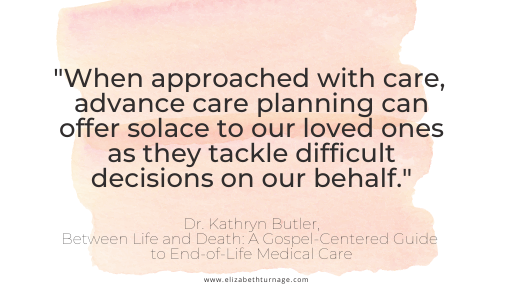
Quote from Dr. Kathryn Butler
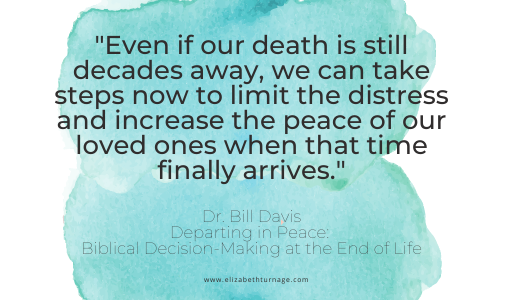
Quote from Dr. Bill Davis

t3. Appoint a Durable Power of Attorney. 

Appoint someone who will have the legal power to act on your behalf if you are incapacitated. My mother had appointed me as her power of attorney and put my name on her checking account before she died. Thanks to her foresight, paying her bills after her death did not involve jumping through legal hoops. It is often a good idea to make your durable power of attorney and health care surrogate the same person.

4. Make a will and appoint an executor. 

Make a will and appoint someone to be in charge of handling all of your affairs after your death.

5.  Gather essential information. 

Not only will your family benefit if you gather all of the details of your life into one place, you will. Can you imagine the peace of knowing exactly where to locate details about your medical history, personal history, insurance information, titles, credit cards, bills and methods of payment, etc.? 

6. Create a spiritual legacy: stories, values, ideas you want to pass along to the next generation. While I’ve listed this last, this is the gift that your loved ones will likely cherish most for years to come. The other items provide a practical roadmap for the early season following crisis or death, but a spiritual legacy communicates thoughts and stories that will be treasured forever. You can begin creating and sharing your spiritual legacy now. Think about writing a yearly birthday card or Christmas letter in which you share how your loved one has uniquely blessed your life. 

While it’s a good bit of work to gather these items, it’s doable.  I went through the process for the first time in 2017, after my father died. I used the AARP resource, Checklist for My Family (affiliate link), and  made appointments on my calendar to spend forty-five minutes three times a week over a period of several months. Now I am updating my information and using the NOLO resource, Get It Together: Organize Your Records So Your Family Won’t Have To (affiliate link), which is a little newer and more detailed than the AARP resource. I’ve spent about forty-five minutes three days a week, and I’m almost finished after only three weeks. If you’d like the accountability, assistance, encouragement of a workshop for going through this process, sign up today to be part of the beta group for the 12-week workshop that begins in September.

Step 3: Once you’ve begun the process of preparing your materials, discuss it with your adult children and loved ones. 

The best time to discuss your own death and dying is, as we told our kids recently when we had this conversation, when you’re not sick or in crisis. Ideally, choose a time when you’ll all be together. Let them know in advance that you are not expecting to die anytime soon, but even so, you’d like to discuss some things about the end of your life with them so that they will be prepared if there is a crisis. Then, when you gather, give them the password to your phone and password keeper (assuming you feel comfortable with all of them knowing), and tell them where you will keep your binder or files (usually in a safe, for which they will also need the code). 

For Reflection

Have you benefited from someone else leaving you a legacy like the one described? What other preparations would you like to make? What are the challenges? What do you think are the benefits and joys?

Get help organizing your life and legacy!

Starting in September, I will walk alongside you as you gather all the materials you need to prepare a legacy that gives peace to you and your loved ones both now and in the future. Over 12 weeks, we’ll gather online to cheer each other on and to learn tips for organizing your life and legacy.

A Prayer about Protection from Enemies

A Prayer about Protection from Enemies

God of Justice,

We join David in Psalm 17, 

asking you to hear our prayers against the enemy and any tools 

he may use on this earth in his plans of attack.

For those who have been betrayed, marginalized, treated unfairly, 

you have given us words to pray: 

“Wondrously show your steadfast love, 

O Savior of those who seek refuge 

from their adversaries at your right hand” (Psalm 17:7).

Even on the days when it seems like you don’t hear our prayers, 

remind us that you have heard them, 

that you have already begun 

to show us your steadfast love; 

you have already sent the refuge 

that will hide us in the “shadow of your wings,” 

Jesus, our compassionate protector.

Even on the days 

when it feels like “deadly enemies surround” us (Psalm 17:9), 

draw our eyes to look for the day 

when David’s words will come true for us, 

“As for me, I shall behold your face in righteousness; 

when I awake, I shall be satisfied with your likeness” (Psalm 17:15).

In the name of the Savior who is our safe place.

Amen. 

A Prayer about Resisting the Enemy

A Prayer about Resisting the Enemy

Lord of Angel-Armies,

May we never forget or discount the spiritual battle 

that rages right here right now. 

The evil one prowls around like a lip-licking lion, 

drooling over our vulnerability and frailty. 

He is a liar, a tempter, an accuser, and an adversary. 

His minions serve him, 

seeking to deceive us into believing people we know we love are somehow unlovely, 

distract us from our mission to serve and glorify you, 

and degrade the dignity you have shaped into our image-bearing being. 

By the Holy Spirit, you have given us everything we need to defend ourselves 

against the accuser’s stratagems: 

the belt of truth, 

the breastplate of righteousness, 

the gospel slippers of peace, 

the shield of faith, 

the helmet of salvation, 

the sword of the Spirit. 

May we indeed arm ourselves 

against all the “cosmic powers over this present darkness” (Ephesians 6:12),

and resist the devil, that he may flee from us (James 4:7).

In Jesus’ peace-bringing name. Amen.

Read Ephesians 6:10-18.